Messengers reach Ayodhya behind spent horses: Rama has won Sita. Days later, in Mithila, four princes take four hands, and the sky rains flowers.
Sita Ram Vivah. Also known as: the wedding of Rama and Sita, Ram Sita Vivah.
Tap an underlined word for its meaning.
 In a pillared hall of Ayodhya’s palace, its carved stone pillars carrying flat lintels and beams, aged King Dasharatha sits on a gold throne in red and gold robes as three dusty, travel-worn messengers stand before him with joined palms, the first bowing low, while three tired horses stand in a sunlit courtyard beyond the far doorway.
Scene 1 of 9
Three nights on the road
Janaka’s messengers rode into on spent horses, three nights on the road behind them.
They were led into the palace. There sat Dasharatha, old, radiant as a god. Their fear left them. They joined their palms.
“Great king, Janaka of asks again and again after your welfare. With Vishvamitra’s leave, he says this:
“‘My vow is known: my daughter would be won by valour alone. Kings came, failed, and turned away in anger. Now your sons came by chance, following Vishvamitra, and she is won. Before a great assembly, Rama broke that jewel of bows at its middle.
“‘I must give him Sita. Let me keep my vow. Come quickly, with your teachers and your priest. Come and see your sons.’”
 Outside Ayodhya at sunrise, the white-robed sage Vasishtha walks at the head of the procession while King Dasharatha stands with a raised hand in a gold chariot drawn by white horses, followed by elephants, horsemen and soldiers with banners before the city’s tall carved gateway tower.
Scene 2 of 9
Yoke my chariot
Dasharatha’s joy brimmed over. He turned to Vasishtha, to Vamadeva, to his ministers.
“Rama, Kausalya’s joy, is in Videha with Lakshmana, guarded by Vishvamitra. Janaka has seen his valour and wishes to give him his daughter. If it pleases you, we go at once. Let no time be lost.”
“So be it,” said ministers and together.
“Tomorrow we set out,” said the king.
When the night had passed he called Sumantra. “Send the treasurers ahead with wealth and gems. Let the fourfold army march. Vasishtha, Vamadeva, Jabali, Kashyapa, long-lived Markandeya, Katyayana: let them go in front. Yoke my chariot. The messengers are hurrying me.”
ahead, army behind, the king set out.
Four days on the road, and they stood in Videha.
 In a pillared hall in Mithila, blue-skinned Rama kneels and touches the feet of his father Dasharatha, who blesses him from a gold seat, while Lakshmana stands with joined palms, the sage Vishvamitra holds his staff nearby and Vasishtha and other sages look on.
Scene 3 of 9
The gift rests with the giver
Janaka received him with every honour, and his gladness knew no measure.
“Welcome, great king. Good fortune has brought you, and Vasishtha with you, like Indra among the gods. My obstacles are overcome; my house is honoured by this bond with Raghu’s line. Tomorrow at dawn, as my sacrifice ends, let the wedding go forward.”
Dasharatha answered from among the . “I have heard it said: a gift rests with the giver. You know . Whatever you say, we will do.”
Janaka was struck with wonder.
Then Rama came, Lakshmana beside him, Vishvamitra before them, and touched his father’s feet. The old king looked at his sons and was glad.
That night Janaka performed the rites for his sacrifice, and for his two daughters.
 In Mithila’s assembly hall, the white-haired sage Vasishtha speaks with a raised hand beside King Dasharatha, while King Janaka and his younger brother Kushadhvaja listen from two thrones set side by side.
Scene 4 of 9
From Brahma to Rama
At dawn Janaka turned to his priest, Shatananda. “My younger brother Kushadhvaja rules Sankashya, on the river Ikshumati. He guards my sacrifice. Let him share this joy.”
Riders left on swift horses, and Kushadhvaja came. The brothers took their thrones and sent for Dasharatha.
“Vasishtha is as a god to Ikshvaku’s house,” said Dasharatha. “He speaks for us.”
Vasishtha spoke.
“From the Unmanifest came Brahma. From Brahma, Marichi; then Kashyapa; then Vivasvan; then Manu. Manu’s son was Ikshvaku, first king in .”
Name followed name: Mandhata. Sagara, born with the poison a co-wife gave his mother. Bhagiratha. Kakutstha. Raghu. Aja.
“From Aja, Dasharatha. From him, the brothers Rama and Lakshmana. For them I ask your two daughters. Give the worthy to the worthy.”
 King Janaka, crowned and in cream and red, joins his palms and speaks with joy, his younger brother Kushadhvaja behind him, as Vasishtha and Dasharatha listen in the foreground, seen from behind.
Scene 5 of 9
Three times I say it
Janaka joined his palms. “One who gives a bride must name his whole line. Hear ours.
“Nimi, famed through the three worlds. His son Mithi. Mithi’s son, the first to be called Janaka.” On through Devarata, down to his father, Hrasvaroma. “He crowned me, left Kushadhvaja in my care, and went to the forest.
“Mighty King Sudhanva came from Sankashya and besieged . He demanded Shiva’s bow, and lotus-eyed Sita. I refused. We fought, and he fell to me in battle. I crowned my brother in Sankashya.
“With great joy I give Sita to Rama, Urmila to Lakshmana. Three times I say it. There is no doubt.
“Today the star is Magha. On the third day, under Uttara Phalguni, hold the wedding.”
 At dawn in a palace courtyard ringed by flat-roofed pillared halls, with one temple spire rising beyond, King Dasharatha, flanked by his four sons Lakshmana, Rama, Bharata and Shatrughna, gestures in giving toward two brahmanas with joined palms, amid a herd of cows with gold-capped horns, calves and bronze pails.
Scene 6 of 9
Two more brides
Then Vishvamitra spoke, Vasishtha beside him.
“The houses of Ikshvaku and Videha have no equal. One thing more. Your brother Kushadhvaja has two daughters, unmatched on earth for beauty. We ask them as brides for young Bharata and wise Shatrughna. Bind the two houses.”
Janaka joined his palms. “My house is blessed, that you two command it yourselves. So be it. On one day let four princes take the hands of four princesses.”
He rose. “I am your disciple always. As this city is Dasharatha’s, so is mine.”
Next dawn Dasharatha gave the brahmanas a hundred thousand cows for each son: gold on their horns, calves beside them, bronze milking-pails. Among his four sons he shone like Prajapati among the world’s guardians.
 In a pavilion hung with marigold and jasmine, the sage Vasishtha in white kindles the fire on a decorated altar, with Vishvamitra in saffron and the priest Shatananda in yellow holding a ladle, surrounded by golden vessels, sprouting pots, a conch, grain, rice and darbha grass.
Scene 7 of 9
Like flames at the altar
The third day came, and the hour called Vijaya. Rama stood among his brothers, all four adorned, the wedding thread tied, Vasishtha before them.
Vasishtha went to Janaka. “Dasharatha and his sons await the giver.”
“What doorkeeper of mine bars the way?” said Janaka. “Whose order do you await? Who hesitates in his own house? My daughters stand at the altar’s foot, bright as flames. I am ready. Why does the king delay?”
Dasharatha led in his sons and all the .
At the pavilion’s centre Vasishtha raised the altar, with Vishvamitra and Shatananda. He dressed it with flowers, golden vessels, sprouting pots, incense, conch vessels, ladles, dishes of parched grain and unbroken rice. He spread darbha grass, kindled the fire. The offering went in.
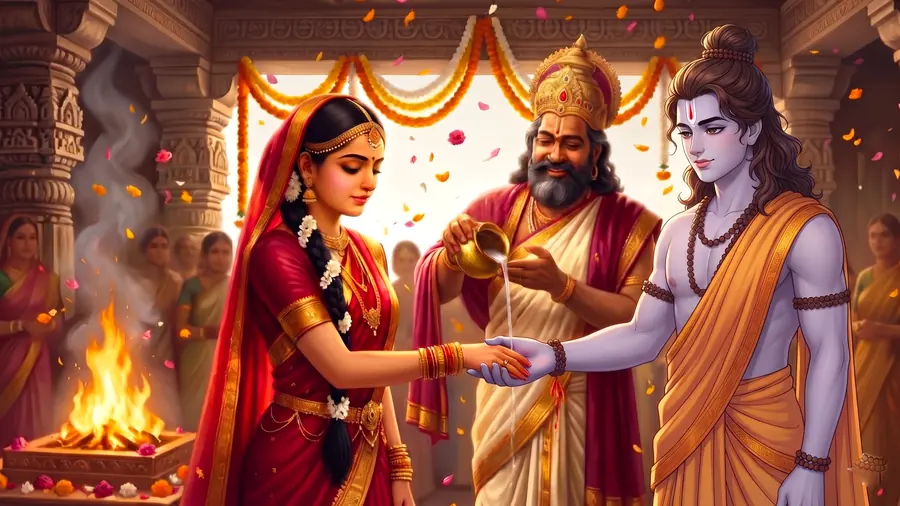
 Beneath a carved stone wedding pavilion hung with marigold and jasmine garlands, before the wedding fire, Sita in a red and gold sari with its upper cloth over her head places her hand in Rama’s open palm, a red wedding thread at his wrist, as King Janaka pours holy water from a gold vessel, while flowers fall from the sky.
Scene 8 of 9
This is Sita
Janaka led Sita in, adorned with every ornament, and set her before the fire, facing Rama.
“This is Sita, my daughter, your partner in . Accept her. Blessings on you. Take her hand in yours. Blessed and devoted, she will follow you always, like your own shadow.”
He poured out the water made holy by mantra.
“Well done! Well done!” cried gods and . The drums of heaven rolled. Flowers fell in a great rain.
Janaka, flooded with joy, spoke on.
“Lakshmana, come. Accept Urmila, whom I offer. Take her hand. Let no time be lost.”
“Bharata, take Mandavi’s hand in yours.”
“Shatrughna, take Shrutakirti’s hand.”
“Sons of Kakutstha, all of you gentle, all true to your vows: be one with your wives.”
 In a garlanded wedding pavilion, Rama and Sita lead the four couples hand in hand around the sacred fire, Lakshmana with Urmila, Bharata with Mandavi and Shatrughna with Shrutakirti following, as small celestial dancers and musicians play among the clouds above.
Scene 9 of 9
Three times round the fire
Four hands took four hands, as Vasishtha directed.
Then the princes of Raghu’s line, each with his bride, walked round the fire, round the altar, round King Janaka, round the .
The sky answered. Flowers fell, shining, out of the open air. The drums of the gods sounded, with song and the music of instruments. Apsaras danced in troops; gandharvas sang sweetly. It was a wonder to see.
Tulsidas tells it this way: as Rama and Sita circled, their lovely reflections glittered in the jewelled pillars.
And through all that music the four brothers went three times round the fire, and were wed.
Then they went to their quarters, their brides beside them. Old Dasharatha followed with the and his kin, watching.
You’ve reached the end of this story.
The end
How this story closes
And through all that music the four brothers went three times round the fire, and were wed.