Out of a dust-dark whirlwind, the axe-bearing son of Jamadagni bars the road home and dares young Rama to draw the bow of Vishnu.
Parashurama meets Rama. Also known as: Parshuram and Ram.
Tap an underlined word for its meaning.
 On the road from Mithila, aged King Dasharatha leans anxiously from his golden chariot toward the sage Vasishtha, who raises a reassuring hand, as dark birds wheel in a stormy sky, deer pass calmly by and the royal procession trails into the dust.
Scene 1 of 9
Birds that shriek
The road home from . When the night had passed, Vishvamitra had taken leave of the two kings, of Rama and of Lakshmana, and gone north to the Himalaya. Janaka had given his daughters countless cows, silks, elephants, horses, chariots and gold, and turned back. Now Dasharatha rode for with his four sons, the ahead, the army behind.
Then the birds began to shriek on every side. Yet the beasts of the earth passed around him on the auspicious side.
“My heart sinks at the birds,” the king said to Vasishtha, “and rises at the beasts. Why?”
“The birds foretell a terror sent by fate,” said Vasishtha. “The beasts say it will pass. Let fear go.”
As he spoke, a fierce wind rose.
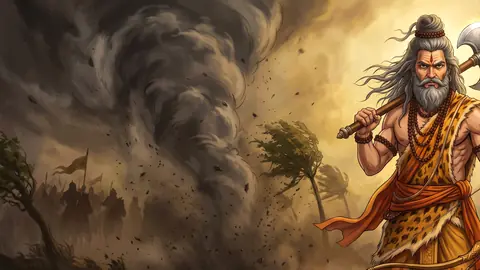
 Parashurama, fierce-eyed with matted hair and a grey-streaked beard, a great battle-axe on his shoulder and a lightning-crackling bow and arrow in his hand, blazes like fire out of a dust-dark whirlwind as trees bend and a distant army fades into the gloom.
Scene 2 of 9
Out of the dark
It came as a whirlwind, shaking the earth, wrenching at great trees. Darkness swallowed the sun. No one could tell one quarter from another. Dust wrapped the army until it stood senseless.
Only Vasishtha and the , the king and his sons kept their wits.
And in that darkness they saw him.
The son of Jamadagni. Bhargava Rama, Parashurama, who had humbled the kings of kings. Matted hair wild about his head. Unshakable as , unbearable as the fire at the end of an age, blazing so bright that common eyes could not hold him. An axe hung from his shoulder. In his hand a bow like massed lightning, and a fierce arrow ready to strike.
He looked like Shiva, destroyer of the three cities.
 White-haired Vasishtha holds out a copper vessel of welcome water, and stern Parashurama, bow upright in one hand and great axe slung across his back, reaches out to receive it, while other sages stand behind with joined palms.
Scene 3 of 9
Has he come again?
The who tend the sacred fires drew together and whispered.
“Has he come to root out the kshatriyas again? His father’s murder drove him to it once. But that rage was spent. Will he begin it all once more?”
Still, they went to him with water of welcome. “Rama,” they said gently. “Rama.”
He accepted Vasishtha’s honour. Then he turned to the other Rama, Dasharatha’s son.
“Your valour is talked of everywhere. I have heard you broke Shiva’s bow. Hearing it, I came, and I have brought another bow. This terrible bow came down to me through Jamadagni. Fit an arrow and draw it to your ear. Show me your strength. If you are worthy, I will give you a duel.”
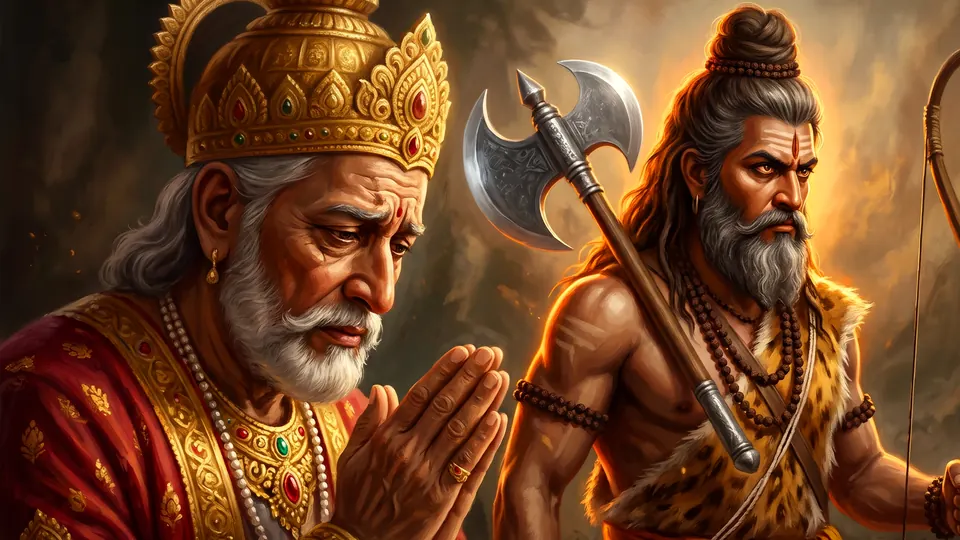 King Dasharatha, crowned and grieving, bows his head with palms joined in plea, while Parashurama, axe on his shoulder and bow in hand, stands behind him and looks past him with fierce eyes.
Scene 4 of 9
A father’s joined palms
Dasharatha’s face fell. He joined his palms.
“You are a brahmana of great austerity. Your anger against the kshatriyas was quieted long ago. Grant my sons safety; they are only boys.
“You are born of Bhrigu’s line, devoted to the Veda and to vows. You promised thousand-eyed Indra that you had laid down weapons. You gave the whole earth to Kashyapa and went to the forest, to Mount Mahendra.
“Or have you come to destroy us all? If Rama alone is slain, none of us will live.”
Bhargava did not heed him. The father’s pleading fell away unheard. He spoke to Rama, and only to Rama.
“There were two bows,” he said.
 In a vision among golden clouds, ash-grey Shiva stands stilled and wide-eyed, his dark bow lowered at his side, facing four-armed Vishnu, who holds his own golden bow with a discus, a conch and a lotus as rings of light spread from him; between them, small in the distance, gods and sages join their palms for peace.
Scene 5 of 9
Two bows of Vishvakarma
“Vishvakarma made them: unsurpassed, mighty, worshipped by every world. The gods gave one to Shiva for his war on Tripura. That bow destroyed Tripura, Kakutstha, and that is the bow you broke. The other they gave to Vishnu. It is this one.
“Once the gods asked Brahma which was stronger, Shiva or Vishnu. Brahma, wanting the truth shown, set the two against each other. A fierce war followed. Then Vishnu gave a single hum. Shiva’s mighty bow went slack, and the three-eyed god stood frozen.
“Gods, and charanas begged them for peace, and peace came. But from that day the gods held Vishnu the greater. And Shiva, in anger, gave his bow, arrow still upon it, to Devarata, king of Videha.
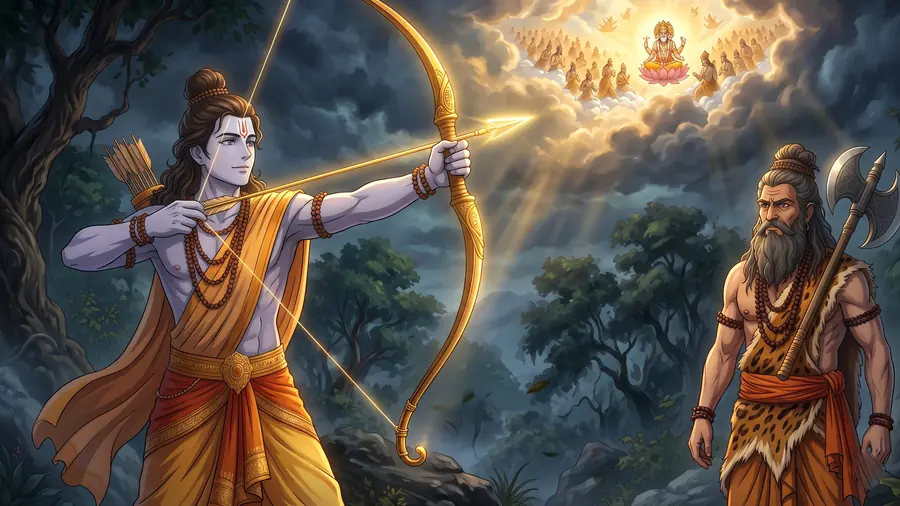
 On the darkened road, Parashurama, axe on his shoulder, thrusts out the bow of Vishnu with an arrow, and young Rama, a red-and-white tilak on his brow and his wavy hair in a top-knot, calm and steady, reaches out his hand to take it.
Scene 6 of 9
Not once, but many times
“This bow Vishnu gave in trust to Richika of Bhrigu’s line. Richika gave it to his son, my father Jamadagni.
“My father had laid all weapons aside. Kartavirya Arjuna, savage of mind, put him to death. When I heard of that foul killing, I rooted out the kshatriyas as fast as they were born, not once but many times. I won the whole earth, performed a sacrifice, and at its end gave the earth to Kashyapa. Now I dwell on Mahendra, and the power of my tapas is in me.
“I heard of the broken bow and came at once. Take this bow of my fathers. Remember you are a kshatriya. Fit the arrow. Take aim. If you can, then we fight.”
 Young Rama, his long wavy hair in a top-knot and a red-and-white tilak on his brow, draws the bow of Vishnu, its glowing arrow aimed toward the sky, as Parashurama watches with his axe on his shoulder and the clouds part to reveal Brahma on a lotus amid a gathering host of celestial beings.
Scene 7 of 9
The arrow cannot fall in vain
Rama answered with courtesy, for his father stood near.
“Bhargava, I have heard what you did to free yourself from your debt to your father, and we honour it. But you belittle me, as if I lacked a kshatriya’s strength. Now see my power.”
Swift-handed, in anger, he took the bow of Vishnu and its arrow from Bhargava’s hand. He strung the bow, set the arrow, and took aim.
“You are a brahmana, and worthy of my reverence, and bound to Vishvamitra. I will not loose this at your life. But the arrow of Vishnu never falls in vain. Your swift motion, or the worlds your tapas won. Choose.”
Above them gathered Brahma and the gods, gandharvas, apsaras, siddhas, kinnaras, yakshas and nagas, to watch.
 Young Rama, his wavy hair in a top-knot and a red-and-white tilak on his brow, holds the bow drawn in profile with a glowing arrow, while Parashurama, his fierceness gone, gazes up at him in awe and recognition, his axe resting against his shoulder.
Scene 8 of 9
I know you now
As Rama took aim, the worlds went senseless. The strength drained out of Jamadagni’s son. He stared up at the lotus-eyed prince, and spoke slowly, softly.
“When I gave the earth to Kashyapa, he told me: do not live in my domain. Since then I never spend a night on earth. Do not take my motion, Raghava. I will go to Mahendra swift as thought. But the peerless worlds I won by tapas: strike those. Do not delay.
“By your touch on this bow I know you. You are the undying Lord of gods, slayer of Madhu. All the gods are watching you. It is no shame to be faced down by the lord of the three worlds. Loose the arrow.”
Rama loosed it.
 As sunlight breaks through the parting clouds and the dust settles, Parashurama walks with joined palms around Rama in reverence, while the young prince stands calm with the great bow.
Scene 9 of 9
Ayodhya in flowers
The worlds of Bhargava’s tapas were gone. The darkness lifted from every quarter, and gods and praised Rama. Jamadagni’s son praised him too, circled him in reverence, and went his way to Mahendra.
Rama, calm again, placed the bow of Vishnu in the hands of Varuna. He bowed to Vasishtha, then turned to his shaken father. “Bhargava has gone. Order the army on to .”
Dasharatha held his son and kissed his head. He felt his son and himself born again.
’s roads were sprinkled with water, strewn with flowers, hung with banners, loud with trumpets. The queens welcomed Sita, Urmila and the two daughters of Kushadhvaja. Silk-clad and shining, the brides worshipped at the shrines, to auspicious chanting and the fires of offering.
You’ve reached the end of this story.
The end
How this story closes
He felt his son and himself born again.