A sage asks if one perfect man exists. Narada answers with a name. Far away, a king lifts a child from a furrow, a prince learns to call back the weapons of the gods, and in Mithila a bow no god could string breaks like thunder.
Sita Swayamvar. Also known as: Shiv Dhanush Bhang, the breaking of Shiva’s bow.
Tap an underlined word for its meaning.
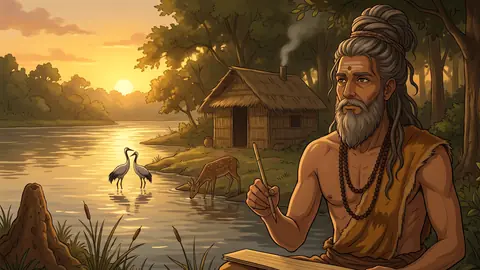
 Outside a thatched hermitage by a forest river, Narada, carrying a veena, arrives to greet Valmiki, who sits on a mat beside stacks of palm-leaf manuscripts; deer graze nearby.
Scene 1 of 11
A sage with one question
Into Valmiki’s hermitage came Narada, the wandering : devoted to austerity and the study of the Veda, best of all who speak.
There was a question Valmiki wanted answered. Now he asked it.
“Is there anyone in this world today,” he said, “who is virtuous and valiant, who knows and remembers kindness, who keeps his word and holds to his vow? Learned, capable, good to every living being? Master of himself, his anger conquered, free of envy? One whom even the gods fear when he is roused to battle?”
He paused.
“I long to hear of such a man.”
 Under a great banyan tree, the two sages sit facing each other in conversation, Narada gesturing with his veena beside him, as sunbeams fall through the leaves.
Scene 2 of 11
Narada names a prince
Narada smiled. He knew the three worlds, and the question delighted him.
“Listen,” he said. “The qualities you name are rare. Hard to find in one person. But I know of such a man, and I will tell you.”
Valmiki did not move. He hardly breathed.
“He was born in the line of Ikshvaku. The people know him as Rama. He has mastered himself. He is valiant, radiant, steady as a mountain.”
One name, and the whole hermitage seemed to hold still around it.
And Narada was not finished. He began to tell the whole of it.
 At sunset, Valmiki sits writing on a palm leaf beneath a tree, while in the clouds above the river a vision appears: three figures walking through a forest, and a shining palace city.
Scene 3 of 11
A whole life in one telling
Narada told it all, in one long breath.
A prince made ready to be crowned. A queen, Kaikeyi, claiming her promised boons. . Lakshmana and Sita walking into the forest beside him. Demons fallen. Sita carried away by Ravana. An alliance with Sugriva, king of the , and Hanuman leaping to search for her. A bridge thrown across the sea to Lanka. Ravana defeated. Sita vindicated. The return to , and a just reign of eleven thousand years.
“Whoever reads this story,” Narada said, “is freed from every sin.”
So his telling ended.
Valmiki had asked for one man. He had been given a world.
 In a ploughed field at sunrise, King Janaka kneels beside a pair of white oxen and a plough, reaching tenderly toward a baby lying among flowers in the furrow.
Scene 4 of 11
The child in the furrow
Years before any of it, in a ritual field, King Janaka was guiding a plough.
It was a sacred : the earth was being made ready for sacrifice. The blade cut its slow line through the soil, after furrow.
And out of that , raised up by the plough from the earth itself, came a girl.
“She was not born from any womb,” Janaka would say long afterward, telling the story to Vishvamitra. He named her Sita, and she was known by that name ever after.
He took her home. He raised her as his daughter.
The king had found his child in the earth. One day, the whole earth would know her name.
 In a forest glade by a waterfall, the white-bearded sage Vishvamitra talks with Rama and Lakshmana as glowing circles, each holding a weapon, float in the air around them.
Scene 5 of 11
The weapons of the gods
Far from , the night after the demoness Tataka fell, the travellers stayed on in her forest. At daybreak Vishvamitra turned to Rama, smiling.
“I am pleased with you, prince,” he said. “I will give you every divine weapon, the ones that humble gods and demons in war.”
The purified himself and, facing east, gave Rama the hymns: words even the gods could not fully grasp.
As he chanted, the weapons came. Not dead iron: living beings, standing close before Rama with joined palms.
“We are your servants, Raghava,” they said. “Whatever you wish, we will do.”
Rama touched each one with his palm. “Stay in my mind,” he told them. “Come when I call.”
 Rama, palms joined, and Lakshmana stand before Vishvamitra, who raises one hand and holds small points of light in the other; deer and a waterfall are behind them.
Scene 6 of 11
The art of calling back
Walking on, face bright, Rama turned to his teacher.
“Lord, I have the weapons now,” he said. “Not even the gods could overcome me. But teach me to withdraw them.”
Not how to send them. How to call them back.
Vishvamitra gave the withdrawals one by one: Satyavanta, Satyakirti, Dhrishta, Rabhasa, Lakshya and Alakshya, and many more.
They came in shining forms. Some glowed like embers, some drifted like smoke, some blazed like sun and moon. With joined palms they spoke.
“Here we are, tiger among men. What can we do for you?”
“Stay in my memory,” Rama said. “Help me when the hour comes. Until then, go as you wish.”
“So be it.” They circled him in reverence, and were gone.
 Seen from behind, Rama and Lakshmana, bows and quivers on their backs, walk a sunlit forest path beside the white-haired sage Vishvamitra, who carries a staff; a distant palace city rises beyond a river valley.
Scene 7 of 11
The road ahead
They went on through the forest, three figures on a sunlit path. The with his staff in front. Two princes behind, bows and quivers on their backs.
No one meeting them would have guessed what they carried. The weapons of the gods rode silently in Rama’s mind, waiting for a call.
Behind them lay the dark forest where the demoness Tataka had fallen. Ahead rose a mountain, and near it a grove as dense and green as a rain cloud, alive with birds and animals.
“Whose hermitage is this?” Rama asked. “I want to hear everything.”
The road was long. At its far end, waiting, was .
 In a pillared hall hung with banners and garlands, a great dark bow lies in an open, ornate chest on an eight-wheeled cart, raised on a flower-lined dais while crowned kings gather around it.
Scene 8 of 11
The bow of Shiva
Kings had come to before. Janaka told Vishvamitra and the princes how it had gone.
The bow belonged to Shiva. At Daksha’s sacrifice, denied his share, the god had raised it in fury against the devas. Pacified, he gave it away, and it came at last to Devarata, Janaka’s ancestor, in trust.
“My Sita rose from the earth,” Janaka said. “I vowed her to valour alone.”
Suitor after suitor had stood before that bow. Not one could lift it. Shamed and furious, they laid siege to for a year, until an army given by the gods drove them off.
Now the bow waited again, and the hall waited with it.
 Beside the open chest holding the bow, Rama stands with palms joined before Vishvamitra, who raises a hand in permission; Lakshmana waits at his side, and King Janaka watches from a golden throne.
Scene 9 of 11
“Show the bow to Rama”
Vishvamitra brought the two princes before the king.
“Show the bow to Rama,” the said.
Janaka turned to his ministers. “Bring the bow,” he said. “The divine one, with its sandal paste and garlands.”
Then, from beyond the doors, came the groan of great wheels. An iron chest rolled in on eight of them, dragged by five thousand tall men straining at every step.
Janaka joined his palms. “Here it is, great ,” he said. “Gods could not string it. Not demons, not gandharvas, not yakshas, not nagas. What chance does a man have? But show it to them.”
Rama did not step forward. He waited for his teacher’s word.
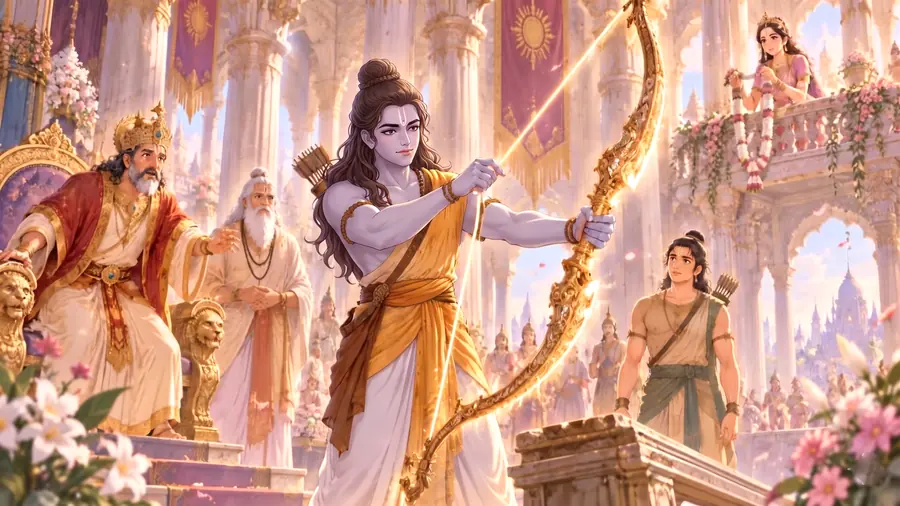 In a pillared palace hall, Rama draws a great golden bow while a crowned king and a white-bearded sage look on from beside a throne; Lakshmana stands nearby, and a young woman watches from a flower-hung balcony.
Scene 10 of 11
Thunder over Mithila
The chest five thousand men had dragged in now stood before him, the bow within.
“Rama, my child,” Vishvamitra said. “Look at the bow.”
Rama stepped close and looked at the bow.
“May I touch it?” he asked. “I will try to lift it, and string it.”
“Yes,” said the . “Yes,” said the king.
Thousands watched. Rama grasped the bow at its middle, almost in play. He strung it as if it were nothing. Then he drew the string back, back toward his ear —
and the bow broke in two.
The crack hit like thunder. The earth shook as if a mountain were splitting. Everyone in the hall fell senseless.
Only four still stood: the , the king and the two princes.
 The great bow lies broken in two across its wheeled chest, petals scattered on the floor; King Janaka raises both arms in joy beside Vishvamitra, Rama and Lakshmana, while riders set out through the open palace gate.
Scene 11 of 11
Riders to Ayodhya
The dust settled. The bow of Shiva lay in two pieces across its chest.
As the people came back to their senses, Janaka joined his palms, every doubt gone from his face.
“I have seen Rama’s valour,” he said to Vishvamitra. “It is a wonder beyond wonders. My Sita, married to Rama, will bring glory to the house of Janaka. I promised her to valour, and my word is kept. She will be his.
“With your consent, my ministers will go swiftly by chariot to . They will tell King Dasharatha all that has happened, tell him his sons are safe in your care, and bring him here.”
“So be it,” said the .
And the chariots set out for .
You’ve reached the end of this story.
The end
How this story closes
And the chariots set out for Ayodhya.