Spritual
Spritual
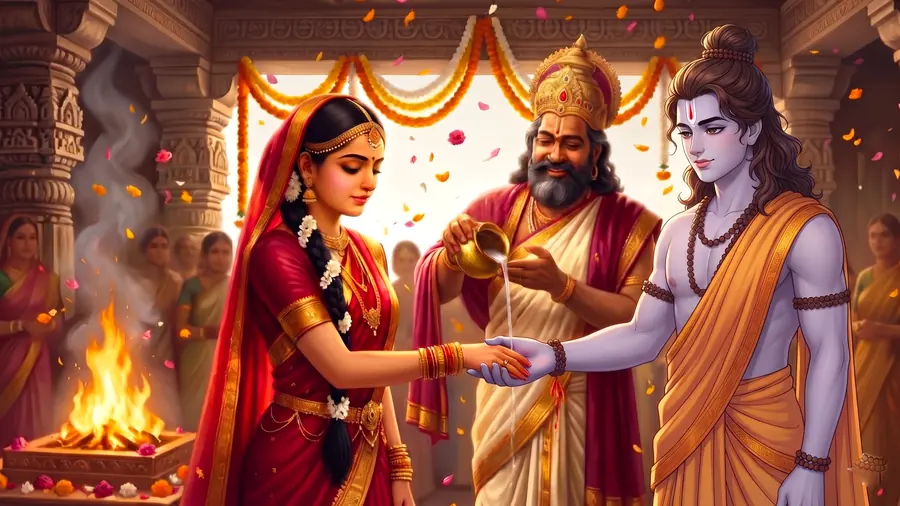
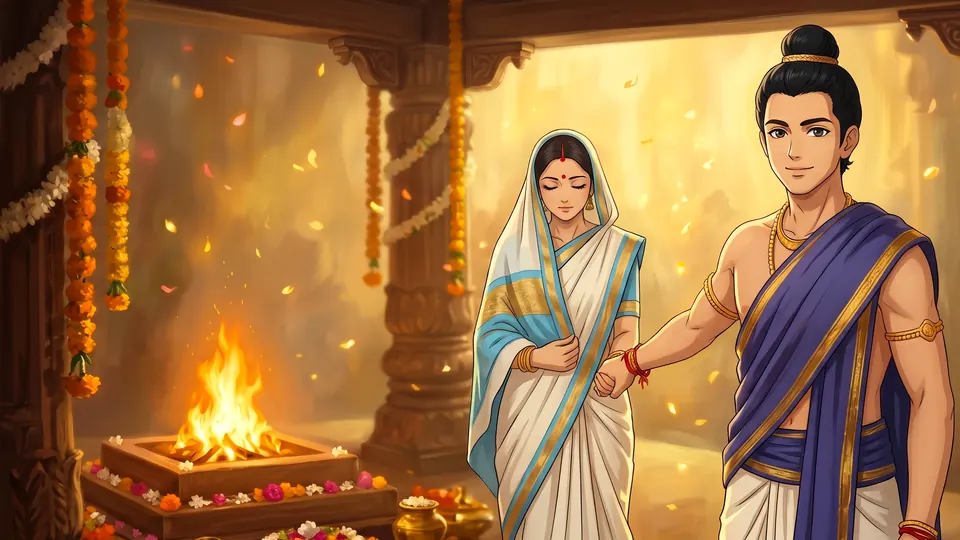
Shatrughna, a young prince in a deep indigo upper cloth with the wedding thread on his wrist, smiles gently as he leads his bride Shrutakirti by the hand round the wedding fire, petals falling through the golden light under the carved wooden beams and garlanded pillars of the Mithila pavilion.

Ramayana

Shatrughna

शत्रुघ्न

Ripusudana · Bharatanugami

Shatrughna, Sumitra’s son, was to Bharata what Lakshmana was to Rama: each held the other dearer than life. When Manthara, the cause of Rama’s exile, was brought to him, he dragged her across the floor in grief and fury, and let her go at a word from Bharata.

Read more

Later, when Bharata offered to fight the rakshasa Lavana, Shatrughna rose from his golden seat: Bharata had suffered enough. With Vishnu’s arrow he slew Lavana and founded Mathura. Tulsidas bows at his lotus feet: brave, gentle, Bharata’s follower.

  • 2 stories
  • 18 scenes
  • 18 min read

Follow this path

Shatrughna, in reading order through the Valmiki Ramayana.

Stories with Shatrughna

RamayanaBala Kanda

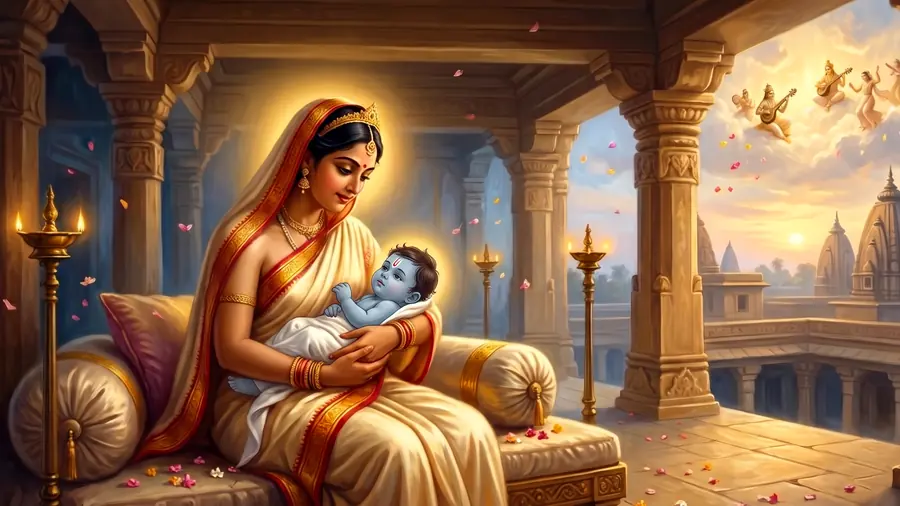
The birth of Rama: The golden vessel from the fire

A sonless king holds a great sacrifice. The gods gathered at it need a man to end Ravana, and Vishnu chooses that king for his father.
  • 9 min
  • Hope
  • Devotion

RamayanaBala Kanda

Sita Ram Vivah: Four brides, one fire

Messengers reach Ayodhya behind spent horses: Rama has won Sita. Days later, in Mithila, four princes take four hands, and the sky rains flowers.

  • 9 min
  • Respect
  • Hospitality

Names

Shatrughna. Also known as: Ripusudana, Bharatanugami.

Where this comes from

What this page about Shatrughna was checked against: each point, and where it is found.
  1. Born to Sumitra together with Lakshmana: Bala Kanda 1.18.14. Named by Vasishtha: 1.18.21-22. Lakshmana’s younger brother (lakṣmaṇāvaraja), dearer than life to Bharata and Bharata to him, set beside Lakshmana’s devotion to Rama: 1.18.28-33. Sources of the story “Sita Ram Vivah”
  2. Called wise (dhīmat) by Vishvamitra when Kushadhvaja’s daughters are asked for Bharata and Shatrughna: 1.72.5-6; Janaka agrees: 1.72.11. Sources of the story “Sita Ram Vivah”
  3. Takes Shrutakirti’s hand at Janaka’s word; circles the fire three times with his brothers: 1.73.32-39. Sources of the story “Sita Ram Vivah”
  4. Goes with Bharata to the home of Bharata’s maternal grandfather (with Yudhajit): 1.77.17-19. Sources of the story “Sita Ram Vivah”
  5. “Sumitranandana” (son of Sumitra) and “Lakshmananuja” (Lakshmana’s younger brother) are plain descriptive compounds resting on 1.18.14 and 1.18.32, not quoted epithets. Sources of the story “Sita Ram Vivah”
  6. Tulsidas bows to Shatrughna by the name Ripusudana and calls him brave, gentle, follower of Bharata (रिपुसूदन पद कमल नमामी। सूर सुसील भरत अनुगामी॥). Source for the title ‘Ripusudana · Bharatanugami’ (रिपुसूदन · भरतानुगामी; the second is the compound of Tulsidas’s ‘भरत अनुगामी’). Tulsidas, Ramcharitmanas, Bal Kand, chaupais before doha 17 (IITK RCM 1.17)
  7. As Lakshmana went with Rama, so Shatrughna went with Bharata, drawn to him (lakṣmaṇo hi yathā rāmaṃ tathāsau bharataṃ gataḥ). Spoken by Manthara (also at 2.8.6: Shatrughna is as faithful to Bharata as Lakshmana to Rama); it repeats the narrator’s own comparison at Bala Kanda 1.18.28-33. Source for the line ‘was to Bharata what Lakshmana was to Rama’. Valmiki Ramayana, Ayodhya Kanda, Sarga 8, verses 6 and 29
  8. The doorkeeper seizes Manthara (Sanskrit 2.78.8 singular dvāḥstho … nyavedayat; the translation says door-keepers), adorned in royal clothes and ornaments, and hands her to Shatrughna as the woman by whose act Rama is in the forest and their father dead; in deep grief and red-eyed rage he drags her, crying, along the floor; Bharata tells him women are not to be killed and that Rama would not speak to them if she were; Shatrughna turns from his anger and releases her. Source for the sentence about Manthara: the retelling says only that she was brought to him, and does not name the doorkeeper. Valmiki Ramayana, Ayodhya Kanda, Sarga 78, verses 5-12, 16, 21-24 (doorkeeper 8, dragging 16, release 24)
  9. Rama asks whether Bharata or Shatrughna shall slay the rakshasa Lavana; Bharata says “I will slay him”; Shatrughna rises, leaving his golden seat, and says Bharata has already done a great work, governing Ayodhya without Rama, sleeping on a bed of sorrow, living on fruits and roots and wearing rags, and should not suffer more. Source for the line “Shatrughna rose from his golden seat: Bharata had suffered enough”. Dutt calls Lavana a Rakshasa and night-ranger (pp. 1763, 1780-1781) and his father Madhu an Asura; hence “the rakshasa” in the retelling. Valmiki Ramayana, Uttara Kanda, Section LXXVI, tr. M. N. Dutt (Calcutta, 1894), pp. 1763-1764 (Dutt’s section numbers differ from other editions)
  10. Rama gives him the unfailing arrow that Vishnu made to slay Madhu and Kaitabha; Brahma tells the gods it was made by Vishnu; with it Shatrughna pierces Lavana’s heart and Lavana falls. Source for the line ‘With Vishnu’s arrow he slew Lavana’. Valmiki Ramayana, Uttara Kanda, Sections LXXVII and LXXXII, tr. M. N. Dutt (Calcutta, 1894), pp. 1766-1767, 1780
  11. Rama tells him he is able to found a city on the Yamuna; after slaying Lavana he asks the gods for Madhu’s city as his capital, and in twelve years the city on the Yamuna is reared and filled with people; at the end his son Subahu is placed on the throne of Mathura. Source for ‘founded Mathura’ (Hindi ‘मथुरा बसाई’). Valmiki Ramayana, Uttara Kanda, Sections LXXVI, LXXXIII and CXXI, tr. M. N. Dutt (Calcutta, 1894), pp. 1764, 1781-1782, 1927
About these sources
  • His later deeds in the Uttara Kanda (Lavana, Mathura) are not told in this story and are not claimed.

Reading comfort

Text size
Colour

Colour waits while Night Lamp is on.

Motion

Light mode keeps the paintings still, with one slow drift and no depth effect. Easier on older phones and batteries.

Night Lamp

Warm amber text on near-black. Paintings fade slowly and hold still.

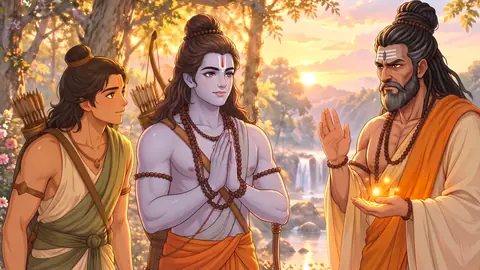
Rama turned to his teacher and asked for the knowledge of withdrawal.

Saved on this device.