A scent on the Yamuna, a father’s silence, and a son who gives up a throne, then the sons who might have claimed it.
Bhishma Pratigya. Also known as: Bhishma’s vow, the vow of Devavrata.
Tap an underlined word for its meaning.
 On the wooded bank of the Yamuna in golden light, Satyavati sits in her small rowing boat holding an oar and looks toward the viewer, while King Shantanu stands among the trees behind her, gazing at her.
Scene 1 of 9
A scent on the Yamuna
Four years after King Shantanu made his son Devavrata his heir, he was wandering in the woods on the bank of the Yamuna when a sweet scent reached him. It came from nowhere he could see. He followed it, this way and that, and in his wandering he beheld her: a black-eyed maiden of celestial beauty, the daughter of a fisherman. The fragrance was hers.
“Who are you?” the king asked. “Whose daughter? What do you do here, timid one?”
“Blessings on you,” she said. “I am the daughter of the chief of the fishermen. At his command, to earn merit, I row travellers across this river in my boat.”
Seeing her beauty, her gentleness and that fragrance, Shantanu desired her for his wife.
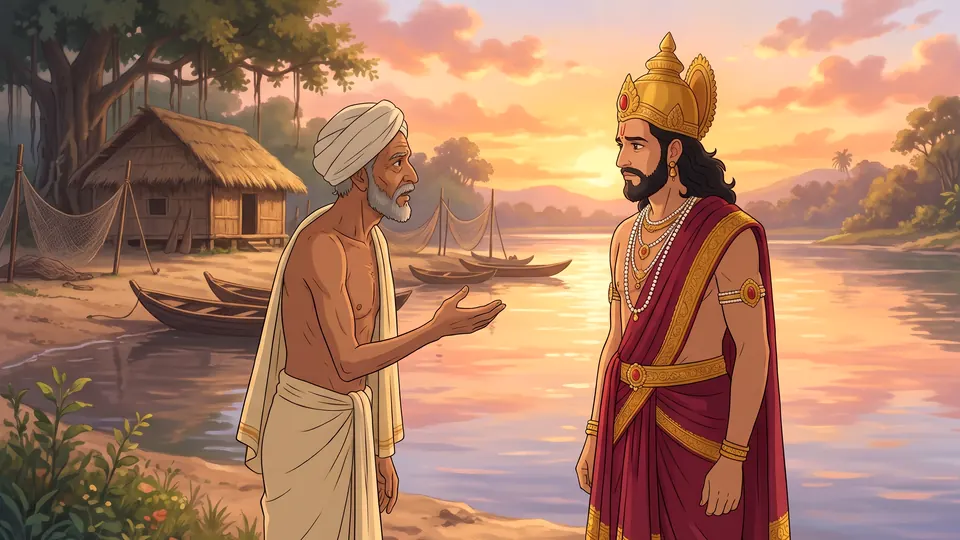 On the river bank at sunset, beside a thatched hut, drying nets and small boats, the bare-chested old fisher-chief in a white turban speaks with an open hand, while King Shantanu, in a tall gold crown and maroon robes, faces him with a troubled look.
Scene 2 of 9
The fisher-chief’s price
The king asked her father for her hand.
“From her birth,” said the chief of the fishermen, “she was meant to be given to a husband. But hear the desire long carried in my heart. You are truthful. Give me a pledge, and I will bestow her on you, for I could never find her a husband equal to you.”
“Tell me the pledge first. If it can be granted, I will grant it.”
The fisherman named it. “The son born of this maiden shall be installed on your throne. No one else shall be your successor.”
The king had no wish to give such a promise, though desire burned in him like fire. He went back to Hastinapura, thinking of her all the way.
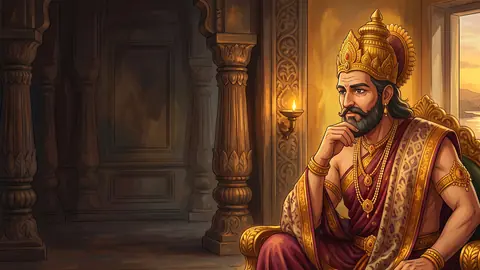
 In a lamplit palace hall at night, King Shantanu sits sorrowfully on his throne, gazing down, while young Devavrata, a bow on his shoulder, stands before him with concern.
Scene 3 of 9
A king who no longer rides
In his palace the king sat in sorrowful silence, and the days went by. Then Devavrata came to him.
“All is prosperity with you,” the prince said. “Every chief obeys you. Why do you grieve? You are lost in your own thoughts and do not answer me. You no longer go out on horseback. You look pale and thin, as if the life has gone out of you. Tell me what sickness this is, so that I may try to find a remedy.”
Shantanu looked at his son: the youth Ganga had given back to him, master of every weapon, the heir he had installed before all the Pauravas.
“You speak truly,” he said. “I have become melancholy. I will tell you why.”
 A close view of Devavrata lowering his eyes in thought beside a single oil lamp, while his father Shantanu, seated behind him, speaks with a worried face.
Scene 4 of 9
One son is no son
“You are the only shoot of our great line,” the king said. “You are always at your sports of arms and deeds of valour. And I keep thinking how unsteady human life is. If some danger overtakes you, child of Ganga, we are sonless. You alone are a hundred sons to me, and I do not wish to marry again.
“But the wise say that he who has one son has no son. You are a hero of fiery temper. You may well fall on the field of battle. Then what becomes of the Bharata line? That thought has made me melancholy.”
Devavrata reflected for a while. Then he went to the old minister, to ask him the cause of the king’s grief.
 By the river in daylight, Devavrata, carrying a bow and a quiver of arrows, arrives with three white-bearded elder chiefs, and the fisher-chief welcomes him with joined palms beside a thatched pavilion with a carved seat spread with a woven mat.
Scene 5 of 9
What the old minister knew
The old minister, devoted to the king’s welfare, told him of the boon the chief of the fishermen had demanded for his daughter Gandhavati.
Devavrata gathered many Kshatriya chiefs of venerable age and went with them to the fisher-chief himself, to ask for the maiden on his father’s behalf. The chief received him with every honour and seated him in his court. Then he spoke.
“You are the first of all who bear weapons, and Shantanu’s only son. Even Indra, if he were the bride’s father, would regret refusing such a proposal. The great man of whose seed Satyavati was born is your equal in virtue, and he has told me often that only your father is worthy of her.”
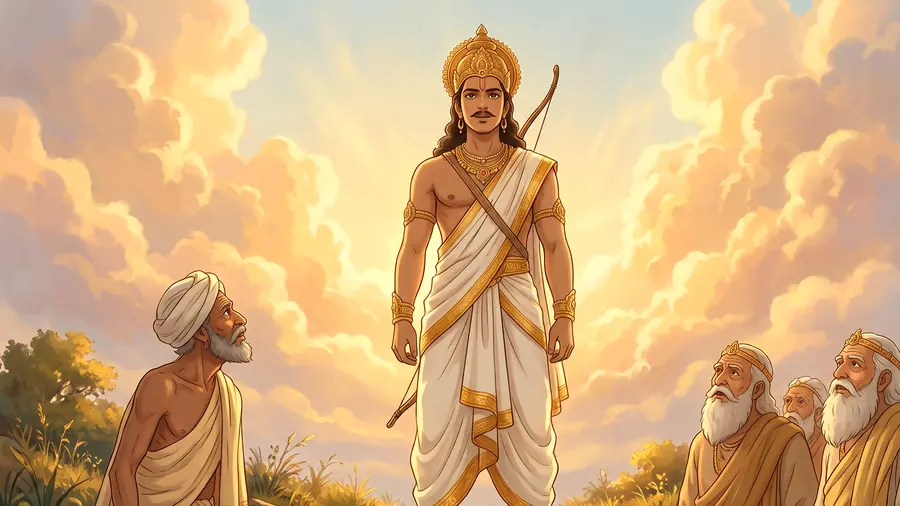
 Against towering golden clouds, Devavrata stands tall and calm as he speaks his vow, while the fisher-chief and three elder chiefs look up at him in astonishment.
Scene 6 of 9
Our king shall be her son
“Let me tell you, I have even refused the celestial Asita, best of Brahmarshis, who often asked for her hand,” the chief went on. “I have one word to say for this maiden, and only one. A co-wife’s son is a rival. Whoever has you for a rival, even an Asura or a Gandharva, is never safe. That is my only objection.”
Devavrata answered in the hearing of all the assembled chiefs.
“Foremost of truthful men, listen to the vow I utter! The man has not been born, and never will be, who would dare such a vow. I will accomplish all that you demand. The son born of this maiden shall be our king.”
 At dusk by the violet river, the fisher-chief speaks his doubt with an open hand, while Devavrata listens calmly beside him.
Scene 7 of 9
Sons not yet born
Then the fisher-chief, driven by the wish to see his daughter’s son a king, reached for what was almost impossible.
“You came here as your father’s full agent. Act for me as well, then, and give my daughter away on my behalf. But there is something more for you to weigh. Those who have daughters must say what I say. The promise you have made before these chiefs for Satyavati’s sake is worthy of you. I have not the least doubt that you will keep it.
“My doubt is about the children you may beget.”
The son of Ganga, devoted to truth, understood the fisher-chief’s scruples. For his father’s sake, he spoke again.
 Flowers rain from a radiant, opening sky onto Devavrata, who stands serene by the river, while the fisher-chief cries out with joy and three elder chiefs look up in awe.
Scene 8 of 9
Flowers from an open sky
“Chief of fishermen, best of men, hear what I say before these kings. Kings, I have already given up my right to the throne. Now I will settle the matter of my children. Fisherman, from this day I take the vow of brahmacharya. If I die sonless, I shall still reach the regions of undying bliss in heaven.”
The fisher-chief’s hair stood on end with joy. “I bestow my daughter!” he cried.
At once flowers began to fall from the sky. The Apsaras, the gods and the tribes of rishis rained them down on Devavrata’s head. “This one is Bhishma!” they cried.
Bhishma: the terrible one.
 In the palace at Hastinapura, before a great arch opening onto the sunlit city, King Shantanu raises his palm in blessing toward Bhishma, who stands with joined palms and bowed head.
Scene 9 of 9
Death at his command
Then, to serve his father, Bhishma turned to the maiden. “Mother,” he said, “mount this chariot. Let us go to our home.”
He helped her up himself. At Hastinapura he told his father everything, exactly as it had happened. The assembled kings praised the deed, one by one and all together. “He is truly Bhishma!” they said.
Shantanu heard what his son had done, and he was greatly pleased. He gave the prince a boon.
“Death shall never come to you while you wish to live. Death shall come near you, sinless one, only after it has first received your command.”
You’ve reached the end of this story.
The end
How this story closes
Death shall never come to you while you wish to live.