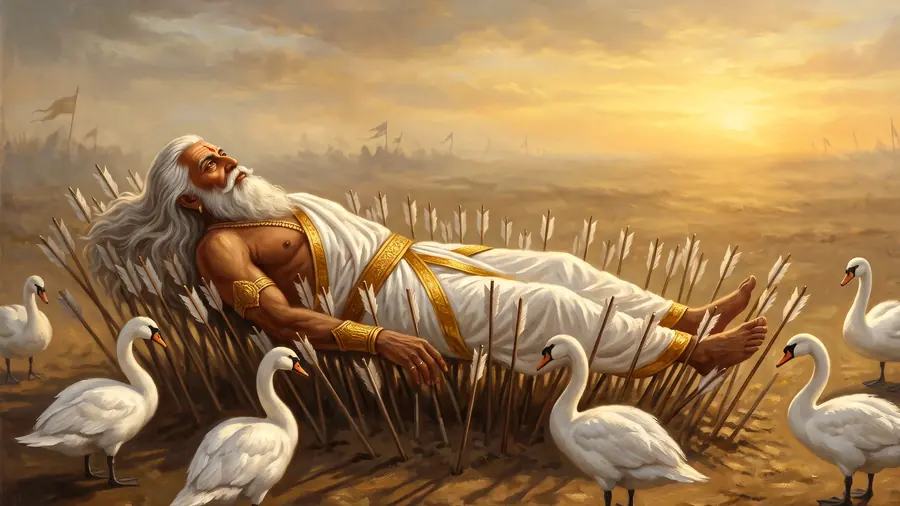
He told the Pandavas how to bring him down. Then, held above the earth by arrows, he lay there fifty-eight nights and gave up his life only after the sun had turned north.
Bhishma on the bed of arrows. Also known as: Bhishma Sharashayya, Fall of Bhishma.
Tap an underlined word for its meaning.
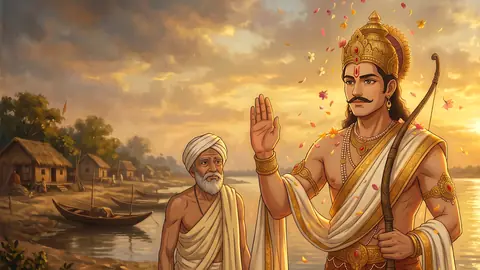
 By lamplight in his tent at night, the white-bearded Bhishma, seated in white robes and gold ornaments with his crown set on a table beside him, raises a hand in welcome to Yudhishthira, Krishna, Arjuna, Bhima, Nakula and Sahadeva, who stand unarmed with heads bowed and palms joined.
Scene 1 of 9
Ask him how he dies
The sun set. That day Bhishma had cut through the Pandava army; in their tents, the Pandavas found no peace.
“He crushes my troops like an elephant crushing reeds,” Yudhishthira told Krishna. “We dare not even look at him. Let me go back to the forest.”
“Then I will fight him myself,” said Krishna.
“No. You vowed not to fight; I will not make your word false. Bhishma promised me counsel, though he fights for Duryodhana. We were children and orphans, and he raised us. Shame on a warrior’s calling! Let us ask him how he can be killed.”
Unarmed, without armour, they entered his tent and bowed their heads.
“Welcome,” said Bhishma. “What can I do for you? However hard, I will do it.”
 At night among the cream camp tents, Arjuna, without armour or crown, presses a hand to his chest, his face full of grief and shame, as Krishna stands beside him listening with a gentle face, a small campfire burning between them.
Scene 2 of 9
Put Shikhandi before you
“Your bow is always drawn to a circle,” said Yudhishthira. “Tell us how to bring you down.”
“While I live, you cannot win,” said Bhishma. “Strike me down; you have my leave. I do not fight a man who drops his weapons, who falls, who flees, or who says ‘I am yours’. Nor do I fight a woman. Drupada’s son Shikhandi was once a woman, later a man. Let Arjuna shoot from behind Shikhandi, whom I will never strike.”
Arjuna burned with grief and shame. “As a child I once called him father. ‘Not your father,’ he told me, ‘your father’s father.’ How can I kill him?”
“You vowed it,” said Krishna. “The gods have already settled it.”
“Then Shikhandi rides in front,” said Arjuna.
 On the dusty plain of Kurukshetra, the white-bearded Bhishma laughs in his chariot with his bow lowered, as Shikhandi, in bronze armour and crimson, has just loosed three arrows toward him from the leading chariot, with Arjuna standing behind in gold armour and Krishna holding the reins and whip.
Scene 3 of 9
Look your last
At sunrise on the tenth day the Pandavas marched out to drums and milk-white conches. Shikhandi rode at the very front. Bhima and Arjuna guarded his wheels.
Later that day, Shikhandi’s three arrows struck the grandsire in the chest. Bhishma saw who had loosed them, and laughed. “Strike me or not, I will never fight you.”
Shikhandi’s anger blazed. “I have heard how you fought Parashurama. I will fight you anyway, and I swear I will kill you. Look your last on this world.”
“Go at him,” Arjuna said. “I will fight behind you.”
Arjuna came on, Shikhandi before him. Every bow the grandsire lifted, Arjuna cut. Bhishma hurled a spear that could split a hill. Arjuna’s arrows broke it into five pieces.
 Bhishma stands in his chariot holding the stump of his cut bow, the other half falling away, and looks up calmly as flower petals and fine spray fall on him from sages and radiant gods in the golden clouds, while Shikhandi in his bronze chariot and, behind him, Arjuna with his bow and Krishna at the reins face him.
Scene 4 of 9
The hour he chose
Then Bhishma thought: “With a single bow I could kill them all, if Vishnu himself were not their guard. And Shikhandi I will not fight. When my father married, he gave me two boons: no one would slay me in battle, and I would die when I chose. Now is the hour to choose.”
From the sky the Rishis and the Vasus answered. “We approve, child. Withdraw your heart from battle.” A fragrant wind blew, carrying fine spray. Cymbals sounded in heaven. Flowers fell on him. No one heard those voices but Bhishma, and Sanjaya, by Vyasa’s gift.
Arrows came on in an unbroken line. Bhishma smiled at Dushasana. “These strike like thunderbolts and bite like winter cold. These are not Shikhandi’s. They are Arjuna’s.”
 A little before sunset on the quiet battlefield, Bhishma lies calm with open eyes on a bed of white-feathered arrows that holds his body above the ground, as six white swans walk around him.
Scene 5 of 9
Arrows held him
He took up sword and shield. Before he could step down, Arjuna shattered the shield into a hundred pieces.
A little before sunset Bhishma fell from his chariot, head to the east, like Indra’s banner torn down. The earth shook.
Arrows held him. His body did not touch the ground.
Clouds let fall a cool shower. Voices cried in the sky: “Why should Ganga’s son die with the sun in the south?”
“I am alive!” he answered.
Ganga sent him the great Rishis, as swans from Lake Manasa. They circled him, wondered at his dying in the sun’s southern course, and flew south.
“Not while the sun is in the south,” he told them. “When it turns north, I go to my ancient home.”
 Bhishma lies held in the air on a bed of upright arrows as a clear jet of water springs from the earth where a single arrow stands and arcs to his lips; Arjuna, without armour, stands barefoot beside the bed with his bow Gandiva lowered, Krishna sits in the chariot behind him holding the reins and whip, and three crowned kings without armour watch with joined hands.
Scene 6 of 9
A pillow of three arrows
Hearing the news, Drona fell from his chariot. Both armies stopped. Kings from each side took off their armour and came to him.
“My head hangs down,” Bhishma said. “Give me a pillow.” They brought the softest pillows. He laughed. “These do not suit a hero’s bed. Arjuna, give me one you think fit.”
His eyes full of tears, Arjuna strung Gandiva and set three arrows beneath the grandsire’s head.
“Had you done otherwise, I would have cursed you. So should a warrior sleep. Here I lie until the sun turns north.”
Next morning he thirsted, but refused their cups. Arjuna drove around him and sent an arrow into the earth just south of him. Up sprang water, cool and pure as nectar.
 At night by the light of a single lamp, Bhishma, lying on his bed of arrows, holds the weeping Karna with one arm around his shoulders as Karna kneels beside him with joined palms; no one else is near.
Scene 7 of 9
Kunti’s son, not Radha’s
“Let this war end with my death,” Bhishma told Duryodhana. “Make peace.” Duryodhana would not hear it.
When the kings had gone, Karna came, weeping, and fell at his feet. “I am Radha’s son, whom you always looked on with hate.”
Bhishma slowly opened his eyes, sent the guards away, and held him with one arm, as a father holds a son. “You are Kunti’s son, not Radha’s. Narada told me, and Vyasa. I bear you no malice; I spoke harshly only to dampen your fire. With the bow you are Arjuna’s equal. The Pandavas are your brothers. Let this enmity end with me.”
“I have lived on Duryodhana’s bounty; I cannot betray him. Give me leave to fight.”
“Then fight,” said Bhishma. “Without anger.”
 On a golden morning Yudhishthira kneels beside Bhishma, who lies held up on his bed of upright arrows, and clasps the grandsire’s raised hand, as Krishna stands near them looking down, the grandsire’s gold crown lying on the ground by the bed; behind them sit Dhritarashtra, Vidura, Kunti and the blindfolded Gandhari beside small sacred fires and an earthen pot.
Scene 8 of 9
When the sun turned north
From that bed Bhishma taught Yudhishthira , giving and wealth, until every doubt was gone. Then he sent him home. “Come back when the sun turns north.”
Fifty nights on, the sun had turned. Yudhishthira came with Krishna, the elders, and Bhishma’s sacred fires. “I am Yudhishthira. If you still hear me, what may I do for you?”
Bhishma opened his eyes and took his hand. “Fifty-eight nights I have lain on these sharp arrows. They felt like a hundred years.”
To Krishna he said, “Give me leave to go.”
“I give it,” said Krishna. “Take your place among the Vasus. Death waits on your wish like a servant.”
“Strive for truth,” Bhishma told them. “Truth is the highest power.” And he embraced them all.
 Ganga, in white and pale blue with a gold tiara and a pink lotus in her hair, stands weeping in her river with a hand at her heart, as Krishna on the sandy bank raises a hand to comfort her; behind him four mourners in wet white cloths stand with cupped palms.
Scene 9 of 9
The river weeps
By yoga Bhishma held his life-breath in one part of his body after another, and each part it left was eased, until no arrow remained. Then his life broke through the crown of his head and rose like a great meteor, and was gone. Flowers fell from heaven.
They wrapped him in silk and garlands for the fire, then went to the river to offer water.
Ganga rose from her stream, weeping. “Not even Parashurama could defeat him. And Shikhandi has slain him! My heart must be adamant, not to break.”
“Not Shikhandi,” said Krishna. “Arjuna felled him in battle, by the warrior’s law. He was a Vasu, born among men by a curse. He has gone to heaven.”
And the great river was comforted.
You’ve reached the end of this story.
The end
How this story closes
And the great river was comforted.