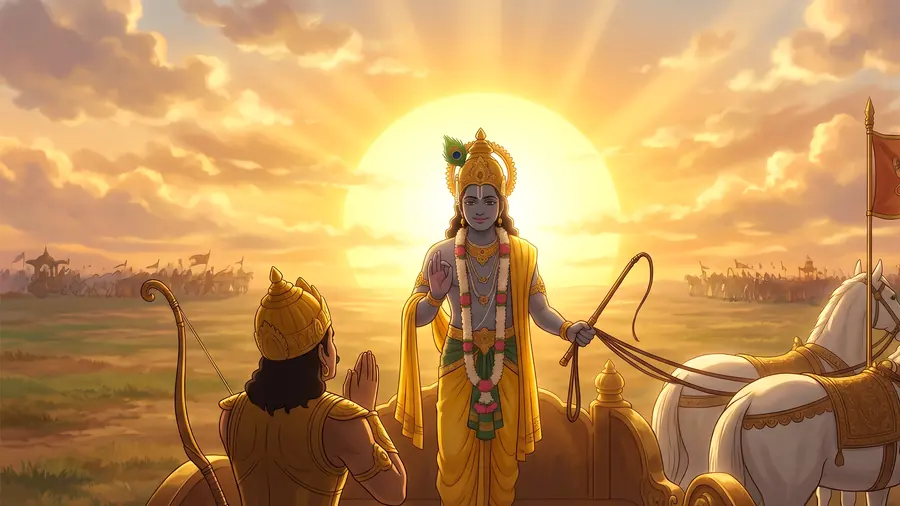

Between two armies, Arjuna lets his bow fall, and his charioteer begins to speak.
Krishna and Arjuna at Kurukshetra. Also known as: Bhagavad Gita, Gita Upadesh.
Tap an underlined word for its meaning.
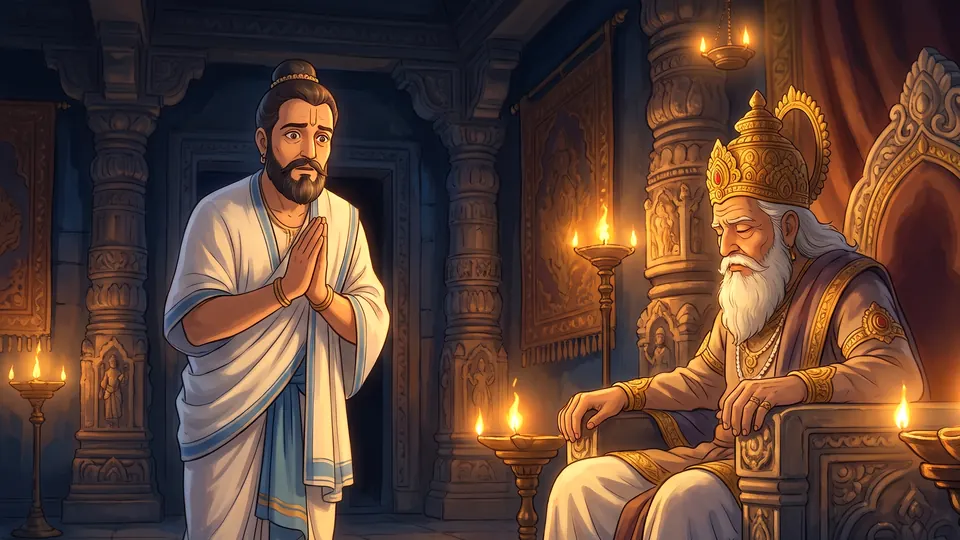 In a lamp-lit stone palace hall at night, Sanjaya stands with joined palms before the blind king Dhritarashtra, who sits lost in thought on his carved throne with eyes closed.
Scene 1 of 9
The blind king’s question
“Bhishma has fallen.” Sanjaya had come back from the field with the news no one wanted to hear, to the old king, who sat lost in thought.
Dhritarashtra could not see the war. Before it began, the Vyasa had offered him sight to watch it, and the king had refused; he did not wish to look upon the slaughter of his kin. So Vyasa gave the gift to Sanjaya instead. Nothing on that field, by day or by night, open or hidden, not even a thought in anyone’s mind, would escape his eyes.
Then the king asked him, “On the holy field of Kurukshetra, gathered and eager for battle, what did my sons and the sons of Pandu do, Sanjaya?”
 On his war chariot at dawn, white-bearded Bhishma blows his conch against a huge rising sun while Duryodhana and Drona stand below beside the bannered army.
Scene 2 of 9
The grandsire’s conch
Sanjaya began where the battle began. Duryodhana, seeing the Pandava host drawn up, went to his teacher Drona and named the great warriors on both sides. Then, to cheer him, old Bhishma let out a roar like a lion’s and blew his conch.
Then, all at once, conches and kettledrums, tabors and cow-horns sounded, until the sound was a storm.
On the other side, on a great chariot yoked to white horses, Krishna blew Panchajanya and Arjuna blew Devadatta. Bhima sounded Paundra; Yudhishthira sounded Anantavijaya. The blast rolled through earth and sky and tore at the hearts of Dhritarashtra’s sons.
The arrows were about to fly. Arjuna, whose banner bore the ape, raised his bow.
 Seen from high above, Krishna and Arjuna halt their golden chariot with four white horses on the open ground between two vast armies with elephants and banners.
Scene 3 of 9
Between the two armies
Then Arjuna turned to his charioteer. “Achyuta, place my chariot between the two armies, so that I may see these men who stand here longing for war, the ones I must fight.”
Krishna drove the white horses out into the open ground. He halted the chariot before Bhishma and Drona and all the kings of the earth. “Partha,” he said, “behold these Kurus gathered here.”
And Arjuna looked.
He saw fathers and grandfathers. He saw teachers, and his mother’s brothers, and brothers, sons and grandsons, and old comrades. He saw fathers-in-law, and friends who had done him good. They stood in both armies, armed and ready, and every one of them was his own.
 Arjuna sinks down on one knee against the chariot seat, a hand pressed to his brow in grief, his bow and quiver cast down on the floor, as Krishna, whip in hand, turns to look at him.
Scene 4 of 9
Gandiva slips
Deep pity took hold of him. “Krishna,” he said, “seeing my own people standing here to fight, my limbs give way. My mouth is dry. My body shakes and my hair stands on end. Gandiva is slipping from my hand, my skin burns, I cannot stand. My mind is spinning.”
“I see ill omens, Keshava. I do not want victory, nor kingdom, nor pleasure. Those for whose sake we wanted them stand ready to give up their lives. I would not kill them even for the three worlds. How then for the earth?
“Better that Dhritarashtra’s sons cut me down, unarmed and unresisting.”
He cast aside his bow and arrows and sank down on the chariot seat, his mind overwhelmed by grief.
 Kneeling on the chariot floor with tears on his face and palms joined, Arjuna asks to be taught, as Krishna stands over him with a gentle smile and raised hand.
Scene 5 of 9
“I will not fight”
His eyes were brimming with tears. Krishna spoke to him. “Where has this weakness come from, in this hour of danger? It does not become you, Partha. Shake off this small faint-heartedness. Stand up!”
“How can I shoot arrows at Bhishma and Drona,” Arjuna answered, “men I should worship? Better to live on a beggar’s bread than to kill such teachers. I do not even know which is better, that we win or that they do. My mind is confused about what is right. I am your disciple. I come to you for refuge. Teach me.”
Then he said, “I will not fight,” and fell silent.
Between the two armies, the ghost of a smile on his lips, Krishna began to speak.
 Haloed by an immense setting sun, Krishna stands on the chariot with one hand raised in teaching while Arjuna kneels with joined palms, seen from behind, and the white horses wait.
Scene 6 of 9
The worn-out garment
“You grieve for those who need no grieving,” Krishna said. “The wise mourn neither living nor dead. Never was there a time when I was not, nor you, nor these kings, nor shall we ever cease to be.
“As a man throws off worn-out clothes and puts on new ones, the dweller in the body leaves worn-out bodies and enters new ones. Weapons do not cut it. Fire does not burn it. Water does not wet it. Wind does not dry it.”
Later: “Your right is to the action alone, never to its fruits.” And again: “Do your appointed work; action is better than inaction.”
And of himself: “Whenever righteousness decays and unrighteousness rises, I come forth. Age after age, I am born.”
 Krishna’s radiant universal form fills the sky with many crowned heads and many arms holding a mace, discus, conch, lotus, bow and arrow, galaxies, mountains and a river within his body, as Arjuna stands tiny on his chariot below with joined palms.
Scene 7 of 9
A thousand suns
The teaching flowed on, chapter after chapter. At last Arjuna asked, “Lord of Yoga, if you think I am able to see it, show me your imperishable Self.”
“You cannot see me with these eyes,” Krishna said. “I give you divine sight. Look.”
If the light of a thousand suns blazed out in the sky at once, Sanjaya told the king, it might resemble the splendour of that great being. Arjuna saw the whole universe standing as one in that body. Then he saw Dhritarashtra’s sons, and Bhishma, and Drona, and Karna, rushing into its blazing mouths.
“I am Time, laying waste the worlds,” said the form. “By me these warriors are already slain. Be only the instrument, Arjuna.”
 Under a bright morning sky full of streaming banners and a Hanuman flag, a moustached Arjuna in gold armour stands tall and resolved on his golden chariot holding his bow Gandiva, while Krishna sits smiling at the reins of the white horses and distant warriors on both sides raise conch shells in a joyful shout.
Scene 8 of 9
“My delusion is gone”
Trembling, Arjuna begged forgiveness. “If ever, careless in my love, I called you only ‘Krishna’, ‘Yadava’, ‘friend’, at play or at meals, forgive me. Show me again that form I knew.” And Krishna, gentle once more, comforted him.
When the teaching was complete, Krishna asked, “Have you heard this with a single mind, Dhananjaya? Is the delusion born of ignorance destroyed?”
“It is destroyed,” Arjuna said. “By your grace I have remembered. I stand firm. My doubts are gone. I will do as you say.”
He took up Gandiva and his arrows once more. On the Pandava side the great chariot-warriors raised a tremendous shout, and conches blew across the field.
 In a lamp-lit palace hall at night, Sanjaya stands with a hand on his heart, glowing with wonder, beside the blind king Dhritarashtra on his throne, as a golden vision of Krishna and Arjuna on their chariot shines between the pillars.
Scene 9 of 9
Where Krishna stands
Before the blind king, Sanjaya came to the end of all he had heard on that field.
“So I heard this wondrous dialogue between Vasudeva and the great-souled son of Pritha,” he said, “and my hair stood on end. By Vyasa’s grace I heard this highest secret from Krishna himself, the Lord of Yoga, speaking before my eyes.
“O king, I remember it, and remember it again, and I rejoice again and again. I remember that wondrous form of Hari, and great is my amazement.
“Wherever Krishna, Lord of Yoga, stands, wherever Partha the archer stands, there, I believe, are fortune and victory, abundance, and a right course that never wavers.”
You’ve reached the end of this story.
The end
How this story closes
Wherever Krishna, Lord of Yoga, stands, wherever Partha the archer stands, there, I believe, are fortune and victory, abundance, and a right course that never wavers.