
Seven arrows in a dog’s mouth, a thumb as fee, and a bird whose head only Arjuna can see.
Ekalavya’s thumb and Arjuna’s aim. Also known as: Ekalavya and Dronacharya, Arjuna and the bird.
Tap an underlined word for its meaning.
 In a sunlit palace courtyard at Hastinapura, Drona, tears of joy on his face, hugs the young Arjuna to his chest while three other princes stand silently behind.
Scene 1 of 9
Only Arjuna answered
Drona called the boys apart. One by one, the princes touched their new teacher’s feet.
Bhishma had given them into his care, with rich gifts and a house full of grain. But Drona had come to Hastinapura with an insult still burning in him. King Drupada, once his friend, had laughed at him and cast him off like a common man.
Now he spoke with a full heart. “I carry a purpose. Promise me truly, you sinless ones, that when you are skilled in arms, you will accomplish it.”
The princes stood silent.
Then one voice, Arjuna’s: “Whatever it is, I will do it.”
Drona pulled the boy to his chest, breathed in the scent of his hair again and again, and wept for joy.
 Under a crescent moon and a starry sky, the young Arjuna draws his bow in the dark while Drona watches from the lamp-lit doorway of a thatched hut.
Scene 2 of 9
The lamp goes out
Arjuna never left his teacher’s side. The lessons were the same for all, yet in lightness of hand he pulled ahead.
Drona quietly told the cook: never serve Arjuna his food in the dark, and never tell him I said so.
A few days later, while Arjuna ate, a wind rose and the lamp went out. He went on eating. In the blackness his hand found his mouth from habit.
Arjuna sat still in the dark. Then he rose and went for his bow.
He began to practise at night. One night Drona heard the twang of a bowstring, came to him, and held him close. “Truly I tell you,” he said, “I will make you an archer with no equal in this world.”
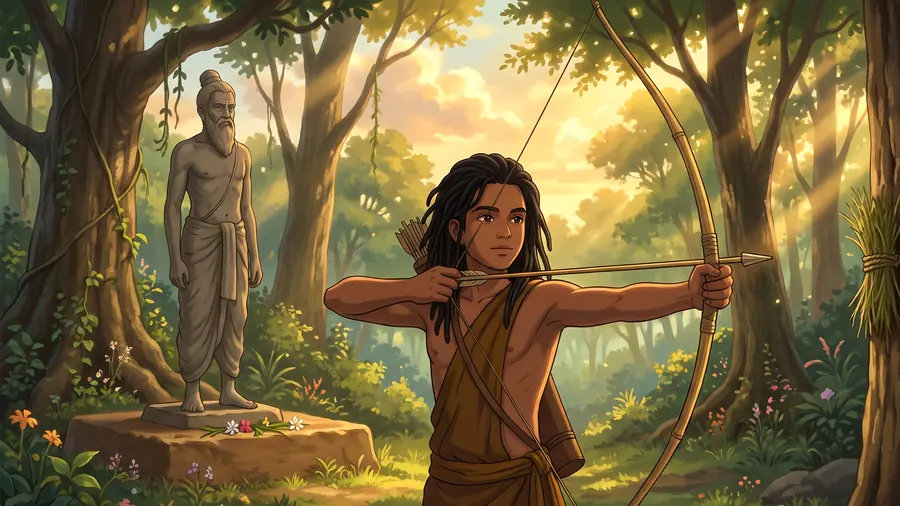
 In a golden forest clearing, Ekalavya draws his bamboo bow at a grass target while the clay statue of Drona he made stands on a flower-strewn earthen platform behind him.
Scene 3 of 9
A prince from the forest
Word of Drona’s teaching spread, and princes came by thousands. Among them came Ekalavya, son of Hiranyadhanus, king of the Nishadas.
Drona would not take him as a pupil in archery. He knew all the rules of right conduct, and he saw what this young man might become: a Nishada who could one day outshine every high-born pupil in his care.
But Ekalavya bowed his head, touched Drona’s feet, and walked back into the forest.
There, among the trees, he shaped a Drona out of clay. He worshipped it as though his teacher stood before him, and in front of that silent figure he practised without fail. Fixing the arrow, aiming, letting fly: all three grew easy in his hands.
 At a forest hunting camp with chariots behind, four astonished princes stare at a dog that trots back holding seven arrow shafts in its mouth.
Scene 4 of 9
Seven arrows in a dog’s mouth
One day, with Drona’s leave, the Kuru and Pandava princes rode out in their chariots to hunt. A servant followed at his own pace, with the gear and a dog.
In the woods the dog wandered off alone and came upon a stranger: dark of skin, his body smeared with dirt, dressed in black, his hair in matted locks. The dog barked and barked.
The Nishada wanted to show how quick his hand was. Before the dog could close its jaws, he sent seven arrows into its open mouth.
The dog ran back to the Pandavas with the shafts in its mouth. The heroes stared. Ashamed of their own skill, they began to praise an archer they had never seen, and went to find him.
 On a veranda at dusk beside a small oil lamp, the young Arjuna kneels with a hand on his chest and questions Drona, who sits listening gravely, the palace of Hastinapura behind them.
Scene 5 of 9
“I am Drona’s pupil”
They soon found him, loosing arrow after arrow without pause: a grim-faced man none of them knew.
“Who are you?” they asked. “Whose son?”
“Heroes, I am the son of Hiranyadhanus, king of the Nishadas. Know me also as a pupil of Drona, labouring to master the art of arms.”
The Pandavas rode home and told Drona of the wonder in the woods.
But Arjuna could not stop thinking of Ekalavya. He went to Drona alone and, trusting his teacher’s love, he spoke.
“You held me to your chest and told me no pupil of yours would ever equal me. Then why is there a pupil of yours, the mighty son of the Nishada king, who is better than me?”
 In a sunset forest, Drona holds out his open hand to Ekalavya, who stands smiling with joined palms, his bow and quiver on the grass, while young Arjuna watches from beside a tree.
Scene 6 of 9
Give me my fee
Drona thought for a moment, made up his mind, and took Arjuna into the forest.
There was Ekalavya: dirt on his body, matted hair, clad in rags, bow in hand, loosing arrow after arrow. Seeing Drona coming, he went a few steps forward, touched his feet, and lay full length on the ground. Then he rose and stood with joined palms, awaiting a command.
“If you are truly my pupil, hero,” said Drona, “then give me my fee.”
Joy came into Ekalavya’s face. “Command me, master. What shall I give? There is nothing I would not give my teacher.”
Drona answered, “If you truly wish to give me a gift, Ekalavya, then I would have the thumb of your right hand.”
 Ekalavya, silhouetted against a huge red setting sun, draws his bow once more while Drona and Arjuna stand quietly watching at the forest’s edge.
Scene 7 of 9
The thumb
The words were cruel. Ekalavya heard them, and he remembered his own: there is nothing I would not give my teacher. He was devoted to truth, and he meant to keep his promise.
He did not hesitate. With a cheerful face and an untroubled heart, he cut off his right thumb and gave it to Drona.
He took up the bow again. He set an arrow with the fingers that remained, drew, and let it fly. But the old lightness of hand was gone: the hand that had put seven arrows in a dog’s mouth before it could close its jaws.
Beside his teacher, Arjuna felt the fever of jealousy leave him.
 At a training ground in golden morning light, Drona stands at a young prince’s shoulder with one hand raised while the prince draws his bow at a carved wooden bird on a tall tree, and three other princes wait behind with their bows.
Scene 8 of 9
The bird on the branch
Each prince found his gift: Bhima and Duryodhana the mace, the twins the sword, Yudhishthira the chariot, Ashwatthama the secrets of arms. But Arjuna outdistanced them all, and his fame reached the edge of the sea.
Then Drona had an artificial bird set at the top of a tree.
“Aim at that bird. When I give the word, cut off its head. Each in turn, my children.”
Yudhishthira was first, bow drawn.
“Do you see that bird on the tree?”
“I do.”
“What do you see now? The tree, me, your brothers?”
“I see the tree, you, my brothers, and the bird.”
“Stand aside,” Drona said, vexed. “This aim is not for you.”
Duryodhana, Bhima, princes from other lands: the same words, each sent aside.
 The young Arjuna stands perfectly still with his bow fully drawn, eyes fixed on a small wooden bird in a sunlit tree, while Drona, holding his own bow, watches a little way off with a quiet smile.
Scene 9 of 9
Only the head
Drona smiled and called Arjuna. “This shot is yours. Turn your eyes to it, and let fly when I give the word.”
Arjuna bent his bow and stood still.
“Do you see the bird there, Arjuna, the tree, and me?”
“I see the bird only. Not the tree, not you.”
Pleased, Drona asked again. “If you see the vulture, describe it to me.”
“I see only its head. Not its body.”
Every hair on Drona’s body stood on end with delight. “Shoot.”
The string sang. The sharp shaft struck the head from the bird and brought it down to the ground.
Drona crushed Arjuna to his chest. In that moment, it seemed to him, Drupada and all his friends were already beaten.
You’ve reached the end of this story.
The end
How this story closes
Drona crushed Arjuna to his chest.