Three cities of gold, silver and iron can fall only to a single arrow, in the one hour they meet. Shiva takes aim from a chariot made of the worlds.
Shiva and Tripura. Also known as: Tripura Dahan, Tripurasura (as the episode is popularly called).
Tap an underlined word for its meaning.
 On a rain-swept rocky height ringed with small fires, three lean ascetic brothers stand on one foot with palms joined above their heads, as four-faced Brahma appears on a pink lotus in a burst of golden light.
Scene 1 of 9
A thousand years on air
On Mount Meru three brothers stood on one foot on bare earth. They stood so for a hundred years.
Their father Taraka was dead, felled by Kartikeya, son of Shiva. Tarakaksha was eldest, Vidyunmali second, Kamalaksha youngest: equal in strength, truthful, disciplined, and enemies of the gods. In summer they ringed themselves with fires. The rains broke on their heads. A thousand years they lived on air alone.
Then Brahma, grandfather of all that lives, stood before them. “I am pleased. Ask.”
“Let no living being kill us. Free us from age and death. What are riches and cities to one whom death swallows in five days?”
“Whatever is born must die,” said Brahma. “Deathlessness is beyond gods and asuras. Ask for something else.”
 The elderly builder Maya, in an indigo upper cloth with a measuring rod and cord, raises his hand as three walled cities rise one above another: gold among the clouds, silver in the sky and dark iron on the earth.
Scene 2 of 9
Gold, silver, iron
The brothers thought a while.
“Then give us three cities the gods cannot break. Gold for Tarakaksha. Silver for Kamalaksha. Iron for Vidyunmali. Let them meet only when a thousand years have passed, at noon, at Abhijit, with the moon in Pushya. Then let one arrow pierce them, loosed by the god in whom all gods live, from a chariot like no other. Shiva has no quarrel with us. We worship him. How would he burn us?”
“So be it,” said Brahma.
At his order Maya, builder of the asuras, raised them by tapas: gold in heaven, silver in the sky, iron on the earth. Wishing-trees grew there. The fire-rite burned in every house, and Rudra had his temples. The three cities shone.
 From a blazing square fire-pit, a vast host of dark spirit-warriors with tridents and spears streams across the dusk sky toward three floating cities of gold, silver and iron, turning to sparks as they reach them.
Scene 3 of 9
My devotees
The gods, scorched by the splendour of the three cities, fled to Brahma. He laughed. “They grew by my favour. They are not mine to end. Go to Shiva.”
They bowed before Shiva. “The three worlds are theirs. Every share of the sacrifice is theirs. No living being can kill them.”
“Those asuras are devoted to me,” said Shiva. “How could I knowingly wrong my own? While they hold to me, they are not to be slain. Tell Vishnu.”
In Vaikuntha, Vishnu had the gods worship the Lord of sacrifice. From the fire-pit rose thousands of bhutas, with tridents, spears and iron clubs.
“Go,” he told them. “Break the three cities. Burn them.”
They entered the cities and were ash, like moths in a flame.
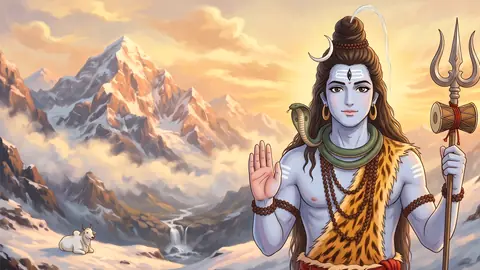
 On snowy Kailasa, Shiva stands grave with both hands open, his trident and drum behind his shoulder, before four-armed Vishnu and four-faced Brahma, who join their palms in plea, with a few crowned gods behind.
Scene 4 of 9
No chariot, no bow
“They are righteous,” said Vishnu. “While they worship Shiva and keep their rites, nothing can ruin them.”
Out of his own self he brought forth a teacher, and sent him into the cities, with four disciples and a teaching that set the Vedic rites aside. Narada vouched for him, and the king took initiation, then his brothers and his people. The fire-rites and the worship of Shiva stopped, and the fortune of Brahma’s boon left the cities.
Vishnu led the gods to . Shiva knew.
“They were my devotees. A ruse took their from them. Must I be their killer?”
“No one else can be,” said Brahma. “You are emperor of the worlds.”
“An emperor with no chariot, no charioteer, no bow?”
 A golden chariot seen from the front floats among clouds and stars, a gold sun wheel on the left and a silver moon wheel on the right, four white horses yoked between rock-ridge shafts; four-faced Brahma sits as charioteer with a rosary and a palm-leaf book, between two river goddesses with fly-whisks, a mountain bow strung with a serpent and one flame-tipped arrow laid before him.
Scene 5 of 9
A chariot made of the worlds
“We will be your chariot,” said the gods, “and everything else.”
“Then count the three cities as destroyed already.”
Vishvakarma built it, golden, out of all the worlds. The sun was its right wheel, with twelve spokes; the moon its left, with sixteen. The six seasons were the rims. The mountains of sunrise and sunset were its shafts; heaven and liberation, its two banners. The four Vedas were yoked as horses, and the syllable Om was the whip. Ganga and the other rivers stood in it holding fly-whisks.
The king of mountains became the bow. The king of serpents became its string. Vishnu became the arrow, and Agni its burning tip.
And the charioteer was Brahma, creator of the worlds.
 Shiva stands with his serpent-strung mountain bow in the sagging golden chariot, its sun wheel on one side and moon wheel on the other; all four white horses lie collapsed in the dust in front, a great dark bull strains beneath the chariot floor on sinking knees, and four-faced Brahma holds the reins.
Scene 6 of 9
The horses fall
Shiva stepped into the chariot, and the horses that were the Vedas fell headlong.
The earth shook. Mountains swayed. Shesha himself trembled under the weight.
Vishnu became a great bull and heaved the chariot up from beneath. For a moment it held. Then the bull too sank to his knees.
At the Lord’s word the reins drew tight, the horses rose, and Brahma drove, swift as thought, toward three cities hanging in the sky.
Shiva turned to the gods. “Make me lord of the pashus, the herd, and count yourselves among it. Only so can those asuras be slain.”
They wavered. He laughed and promised them release. “So be it,” they said, and the name Pashupati went out through all the worlds.
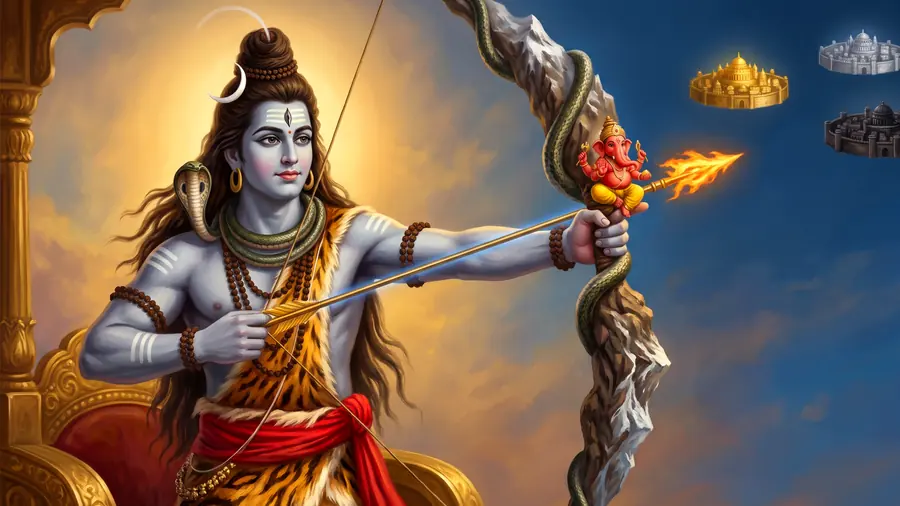
 Shiva stands in the archer’s stance with a flame-tipped arrow set on his mountain bow, a tiny red elephant-headed Ganesha seated on the hand that grips it, while three small cities of gold, silver and iron hang apart in the blue sky.
Scene 7 of 9
A hundred thousand years
Shiva took the archer’s stance: the bow strung, the arrow set, his fist hard on the grip, his eyes fixed.
He stood like that, unmoving, for a hundred thousand years.
Ganesha sat on his thumb. And the cities would not come into his aim.
Then a voice came out of the open sky. “Lord of the worlds, until Ganesha is worshipped, you will not destroy the three cities.”
Shiva heard. He summoned Bhadrakali and offered worship to the elephant-headed Ganesha.
Ganesha was pleased. Shiva looked into the sky: gold, silver and iron, the three cities of Taraka’s sons were drawing into one.
The gods roared. “Victory!”
Brahma and Vishnu spoke. “The hour has come, Mahadeva. Loose the arrow before they part again.”
 Seen from behind in his chariot above the clouds, Shiva holds out his bow as a single blazing arrow strikes three joined cities of gold, silver and iron, which break apart in flame and fall as ash toward the ocean-ringed earth.
Scene 8 of 9
One arrow
In the auspicious moment Shiva drew the bow. The crack of the string was past bearing. He hailed the great asuras and spoke his own name.
Then he let the arrow go.
It flew with the light of countless suns: Vishnu its shaft, fire its head. It burned the three brothers in their cities, and gold, silver and iron fell together as ash onto the ocean-ringed earth.
Tarakaksha burned with his brothers. In that fire he remembered Shiva, his own lord, looked up at him, and spoke in his mind.
“Bhava, we know you. What neither gods nor asuras can reach, we have reached. In every birth, let our minds be full of you.”
They were still speaking when the fire took them.
 Shiva stands calm in a vast golden radiance, his trident lowered in his hands, as four-faced Brahma and the grey-bearded builder Maya bow before him with joined palms, crowned gods watching behind and ash drifting through the clouds.
Scene 9 of 9
Tripurari
Nothing in the cities, moving or still, escaped that fire, except Maya the builder, and those who held to Shiva even in ruin.
The gods saw Shiva blazing in all ten directions like the fire that ends the worlds, and could not speak. Even Brahma was afraid. He bowed. “Ender of the three cities, let me always be your charioteer.”
Then Maya came, unburned. “Ask,” said Shiva.
“Devotion to you that never fails. Compassion for the distressed. And let nothing of the demon stir in me.”
“Granted. Go with your kin to Vitala, lovelier than heaven, and live without fear.”
Shiva vanished, and the chariot, bow and arrow with him.
The , telling of that hour, names him Tripurari: foe of the three cities.
You’ve reached the end of this story.
The end
How this story closes
The Purana, telling of that hour, names him Tripurari: foe of the three cities.