Parvati sets a boy of her own at her door. He will not let even Shiva pass, and all of heaven goes to war against him.
How Ganesha got his elephant head. Also known as: Birth of Ganesha, Ganesh Janm Katha.
Tap an underlined word for its meaning.
 Inside her lamp-lit chamber on Kailasa, Parvati in a red-and-gold sari places a long gold-banded staff into the hands of the radiant young man in a red turban she has just formed, snowy peaks seen through the doorway behind them.
Scene 1 of 9
A son of her own
“Nandi, Bhringi, all the ganas take Shiva’s orders.”
On , long after the wedding, Parvati’s friends Jaya and Vijaya spoke their minds. “In a way they are ours, but our hearts are not one with theirs. We need one of our own.”
Then one day, while Parvati bathed, Shiva rebuked Nandi and walked straight into her rooms. She rose, abashed.
Now she decided. From the scurf of her own body she shaped a youth, flawless in every limb, huge, blazing with strength.
“You are my son, mine alone. I have none but you.”
He bowed. “What is your command?”
“Keep my door. Without my leave, no one comes in.”
She gave him a hard staff, held him close, and set him at the threshold.
 The turbaned boy holds his staff across the carved doorway of Parvati’s palace, barring the way to a stern, ash-blue Shiva with his trident, while ganas come up the snowy path behind.
Scene 2 of 9
The stranger at the door
Parvati went to her bath, untroubled.
And Shiva came to the door.
The boy did not know him. He raised his staff. “My mother is bathing. Without her leave you shall not go in. Go away.”
“Fool! Whom are you stopping? I am Shiva.”
The staff came down on him.
“I am Parvati’s husband,” said Shiva. “This is my own house.” The boy struck him again.
Shiva stood back, furious. “Who is this? Ganas, find out.”
The ganas came. “Leave, if you want to live.” He did not move. Shiva scolded them and sent them back. Now they came with taunts: “A jackal on a lion’s seat!”
The boy raised his staff and struck them while they were still talking.
 The boy stands at the palace threshold with his hand on his thigh in challenge, his staff leaning by the doorpost, as a crowd of armed ganas shouts across the courtyard and a woman in a green sari peeps out from the inner doorway.
Scene 3 of 9
Equals at the door
Shiva waited a krosha from . “Go and beat him,” he told the ganas.
Inside, Parvati heard the uproar and sent a friend to look. The friend came back pleased. “Our gana is holding the door. If they want in, let them win first.”
For a moment Parvati wavered. Then: “What is to happen will happen.” Her word went out: well done; do your duty.
The boy tightened his turban and slapped his thighs. “I am Parvati’s son. You are Shiva’s ganas. We are equals. You keep his orders; I keep hers. You will not enter, by force or by pleading.”
Shiva heard it. “If I give way now, the world will say Shiva bows to his wife. This war must be fought.”
 At the palace door the boy swings a dark iron club as two gana chieftains fall back in the snow, and a great host of ganas spreads out across the slope behind them.
Scene 4 of 9
One against thousands
The ganas came armed for war.
“Welcome,” said the boy. “You have fought many battles. I am one, a boy, and I have never fought at all. Let the goddess see her son’s strength, and Shiva see his ganas’.”
They rushed him, roaring. Nandi seized one of his legs, Bhringi the other. Before they could pull, he struck their hands away, snatched up an iron club and planted himself at the door. The ganas, thousands strong, scattered like deer before a lion.
Shiva sent Brahma to win him over. Brahma came with the , and the boy flew at him and plucked at his beard.
“Forgive me! I am a brahmana. I have come for peace!”
The boy lifted the club. Brahma ran.
 The turbaned boy stands with his iron club before a carved stone doorway that opens on wheeling stars, between a dark Shakti drawing a storm of arrows into her open mouth and an eight-armed Shakti crackling with lightning, while six-faced Kumara grips his spear and small figures flee.
Scene 5 of 9
Two Shaktis
Now Shiva’s anger rose. He sent Indra and the gods, the ganas led by six-faced Kumara, goblins and spirits. They came from every side and hurled every weapon they had at one boy.
Parvati learned of it, and she was furious. She created two Shaktis for her gana. One stood with her mouth gaping like a cave in a dark mountain, swallowing every weapon and flinging it back. The other blazed like lightning, many-armed, vast, terrible.
The earth and its oceans shook. Mountains fell. The sky spun with its planets and stars. Gods and ganas fled. Only Kumara stood his ground.
Then Narada bowed to Shiva. “Lord, delay no more. Make an end of him now, as part of your play.” And he vanished.
 On the snowy field before the door, four-armed Vishnu raises his blazing discus, Garuda flies overhead gripping a broken iron club, the boy stands with his staff, and Shiva strides in with his trident while his bow lies on the ground.
Scene 6 of 9
The trident
Shiva called Vishnu and faced the boy with his army. The boy struck the chief gods with his staff, and Vishnu too.
“Only a stratagem will bring him down,” Shiva thought. Vishnu agreed. “I will bewilder him. Then you strike.”
As Vishnu wove his delusion, the two Shaktis gave their power to the boy and vanished. The boy struck the trident from Shiva’s hand, then his bow Pinaka.
“In all three worlds I have seen no one to equal him,” said Vishnu. The club came at him; his discus split it, and Garuda caught the broken piece. The boy’s staff felled Vishnu. Vishnu rose and fought on.
In that moment Shiva cut off the boy’s head with his trident.
Both armies stood still.
 Parvati stands wreathed in flame as countless Shaktis stream out around her, Narada and two sages kneel at her feet with folded hands, and Brahma, Vishnu and Shiva stand back on the snowy slope.
Scene 7 of 9
A mother’s fury
Narada went to Parvati. “Do not let go of your pride.” The ganas beat their drums. Shiva grew sorrowful.
“All of them, gods and ganas, have killed my son,” Parvati cried. “I will destroy them all, or end the world.”
In a moment she created Shaktis by the hundreds and thousands. “Devour them, gods and , ours and others.” Like fire through dry grass they came. Not Brahma, not Vishnu, not even Shiva could stand before her blaze.
Narada and the bowed at her feet with hymns. “Forgive us, Mother. Give us peace.”
“If my son lives,” she said, “and is made chief among you, there will be peace.”
Shiva told the gods: “Go north. Bring the head of the first creature you meet.”
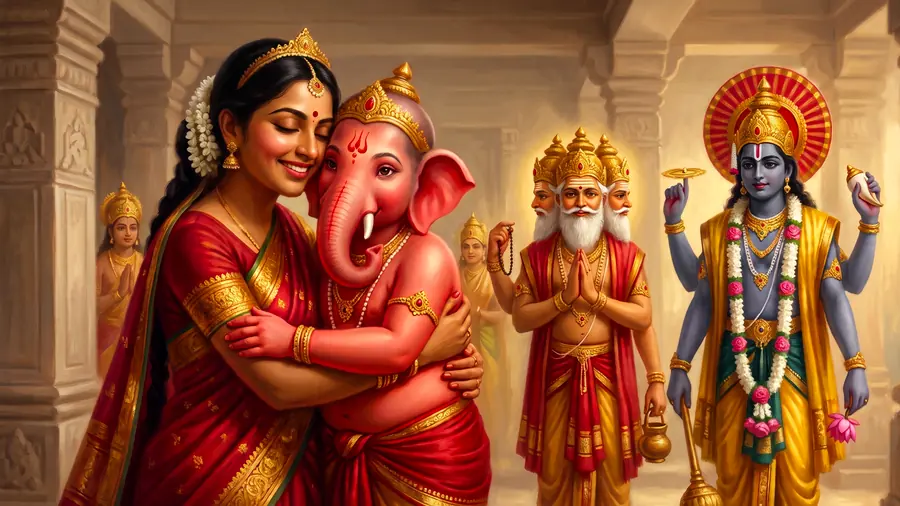
 Parvati, eyes closed and smiling, hugs the crowned, red-skinned, one-tusked elephant-faced boy cheek to cheek in a carved stone hall, while four-faced Brahma with joined palms, four-armed Vishnu and a few crowned gods look on.
Scene 8 of 9
The first creature
The gods washed the boy’s body, honoured it, and set out north. The first creature they met was an elephant with a single tusk.
They brought its head and joined it to the body. Brahma, Vishnu and the gods, remembering Shiva, sprinkled it with water charged by Vedic mantras.
The boy woke, as if from sleep. Elephant-faced, red, radiant, delighted.
They brought him to his mother. Parvati lifted him in both arms and held him close. She dressed him in ornaments, kissed his face, and blessed him.
“You have known pain since your birth. Now you will be worshipped before all the gods. There is vermilion on your face; with vermilion all people will always worship you.”
Now the gods went for Shiva.
 Before a stone temple on snowy Kailasa, the crowned elephant-faced boy sits with joined palms in Parvati’s lap as Shiva lays a hand on his head, four-faced Brahma and four-armed Vishnu stand with joined palms, gods and ganas bow with garlands and a lamp, drums sound and petals fall.
Scene 9 of 9
First, before all
The gods brought Shiva and placed the boy in Parvati’s lap. Shiva laid a hand on his head. “He too is my son.”
The boy rose and bowed to Shiva, Parvati, Vishnu and Brahma. “Forgive my fault. Pride is in the nature of men.”
The three gods spoke as one. “As we are worshipped in the three worlds, so shall he be. He removes every obstacle. Worship him first, and us after.”
Shiva worshipped him first, then Vishnu, then Brahma and Parvati.
“Be lord of all my ganas,” said Shiva. “You were born at moonrise, on the fourth day of the dark half of Bhadrapada. Let your vow be kept that day.”
Drums sounded. Flowers fell. The gods went home, saying, “What a battle!”
You’ve reached the end of this story.
The end
How this story closes
Shiva worshipped him first, then Vishnu, then Brahma and Parvati.