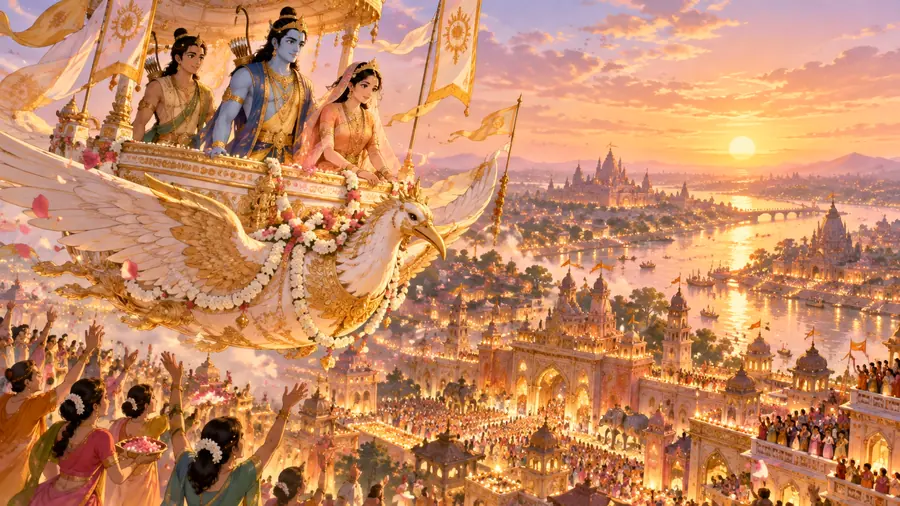
Ravana is dead. Sita walks out of the Ashoka grove, through Rama’s harsh words and into the fire; then the swan-car carries them north, to a brother who has kept a pair of sandals on a throne for fourteen years.
Sita’s Agni Pariksha. Also known as: the return to Ayodhya.
Tap an underlined word for its meaning.
 In the Ashoka grove of Lanka, Sita, in a plain pale saffron sari with tears of relief on her cheeks, sits beneath a blossoming tree and gently raises her hand in refusal as Hanuman kneels before her with palms joined, while the frightened women guards stand huddled among the trees.
Scene 1 of 11
News in the Ashoka grove
Hanuman entered the Ashoka grove, bowed his head and stood silent. Sita sat at the foot of a tree, pale among her guards. Then he spoke. Ravana was dead. Lanka had fallen.
Joy closed her throat. “Not silver, not gold, not the rule of the three worlds,” she said at last, “could repay this news.”
Hanuman joined his palms. “Let me kill the women who tormented you.” Sita answered gently. “Who would be angry with servants who obey their king? There is no one who never does wrong.”
She asked for one thing. “I long to see my husband.”
Vibhishana came with Rama’s word: bathe, be adorned. “I would go as I am.” She yielded, then went out to meet an army.
 On a grassy plain before the golden walls of Lanka, Sita, adorned in a saffron-gold sari, stands with tears on her cheeks and a hand on her heart, answering a grave Rama, while Lakshmana, Hanuman and a hushed crowd of vanara and bear allies look on.
Scene 2 of 11
Ten directions open
She stood before him, head bowed, while and rakshasas watched. “My outrage is answered,” said Rama. “Today I am master of myself.”
His voice hardened. He would not take back a woman who had lived so long in another’s house. “Go where you will. All ten directions are open to you.”
Sita trembled like a creeper struck by an elephant’s trunk. She wiped her tears and answered haltingly.
“Why do you speak to me as a common man speaks to a common woman? My heart was mine to rule, and it lived in you. What could I do with limbs seized by another?”
“Why not send me this word when Hanuman first found me? I would have given up my life before his eyes.”
 At dusk on the plain before Lanka, Sita stands with palms joined before a tall blazing fire, invoking Agni as witness, while a tearful Lakshmana looks back toward Rama, who stands apart with head lowered, and vanara and bear allies watch in anguish.
Scene 3 of 11
Sita walks into the fire
“Lakshmana,” she said. “Build me a pyre.”
He turned to Rama, anger in his face, and read his brother’s will there. He built it. No one dared look at Rama then.
Sita walked around her husband, who stood with head bowed, and went to the blazing fire. Palms joined: “As my heart has never moved from Rama, let Agni, witness of the world, protect me.” She stepped into the flames.
The women screamed. From and rakshasas alike rose one cry: “Alas! Alas!”
The gods came down to Lanka. Then the fire itself rose in bodily form. Agni held Sita in his arms, her red robe untouched, her flowers unwithered. “Here is your Sita. There is no sin in her. Speak nothing harsh to her.”
 At sunset before the golden city of Lanka, Rama holds Sita’s hands as they stand face to face, reunited, while Lakshmana and Hanuman stand with palms joined and the vanara and bear allies rejoice behind them.
Scene 4 of 11
Rama answers the fire
Rama’s eyes filled with tears of joy. Then he answered the god.
“She lived long in Ravana’s house. Had I taken her back untested, the world would have said that Rama, son of Dasharatha, was a fool ruled by desire. I know her heart has never turned from me. Ravana could no more touch her than the ocean can cross its shore. To convince the three worlds, I let her walk into the fire. She is no more apart from me than sunlight from the sun. I can no more cast her aside than a wise man can cast aside his good name.”
Rama took her back. The victor of Lanka, says the poet, knew joy.
Beyond the shore, the long road north was waiting.
 Rama, his long wavy hair in a top-knot, stands in three-quarter view with joined palms beside Sita and Lakshmana, seen from behind, as Indra on his white elephant Airavata blesses from the clouds and the vanara and bear allies rise restored in the grass by the sea.
Scene 5 of 11
The fallen rise
Indra stood before Rama, pleased. “Our coming must not be in vain. Ask.”
Rama asked nothing for himself. “Let every who died for me live again. They left their sons and wives. They counted death as nothing.”
“This boon is hard,” said Indra. “But I have never taken back an offer.”
The fallen monkeys and bears stirred and stood, like sleepers at the end of sleep, their wounds gone. “What miracle is this?” they asked one another.
Pushpaka stood ready, bearing the image of a swan. At Rama’s word, Vibhishana showered the troops with gold and gems. Sugriva and Vibhishana joined their palms. “Take us too. We want to see you crowned.”
“Nothing,” said Rama, “could be dearer.”
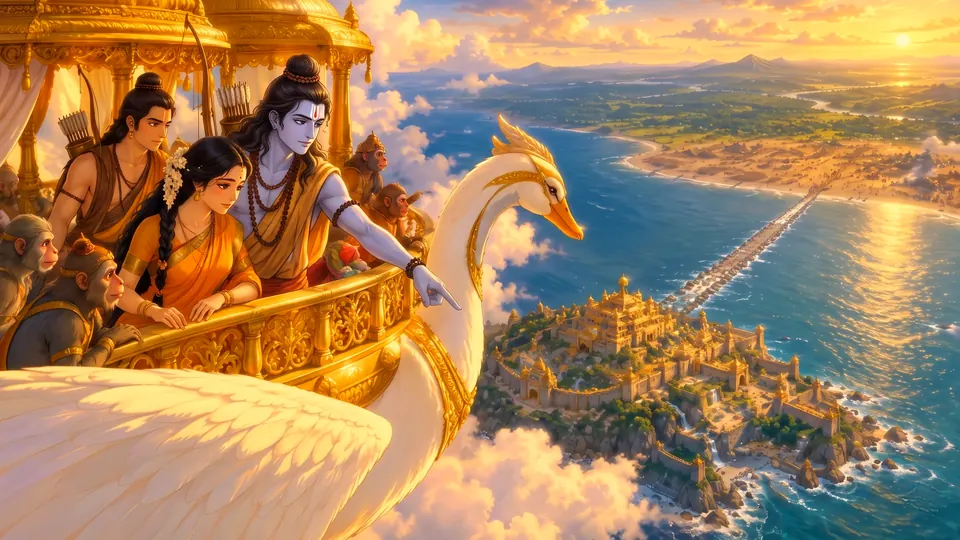 From the railing of the swan-shaped Pushpaka flying high above the sea, Rama points down toward the island city of Lanka and the long stone bridge across the sea as Sita looks where he points, with Lakshmana and vanara companions beside them.
Scene 6 of 11
Lanka falls behind
With a great roar the car rose into the sky. Rama turned to Sita and pointed.
“Look. Lanka, on the peak of Trikuta. There, the field of battle, a mire of flesh and blood. Here Ravana lies. And there, Nala’s bridge, built across the salt sea for your sake.”
The ocean rolled beneath them, boundless and roaring.
Over , Sita spoke. “I want Tara and the wives of the chiefs to come with us to .” The car came down, and rose again fuller.
Rama kept pointing. Pampa, “where I wept, parted from you.” The tree where Jatayu fell. , and their leaf hut, “where Ravana took you by force.”
Below her, mile by mile, ran the road that had come searching for her.
 In a sunlit forest hermitage, the white-bearded sage Bharadwaja speaks to Rama, a red-and-white tilak on his brow and his hair in a top-knot, who sits before him with palms joined beside Sita and Lakshmana, while monkeys and bears eat fruit from the laden trees around the clearing.
Scene 7 of 11
Fruit out of season
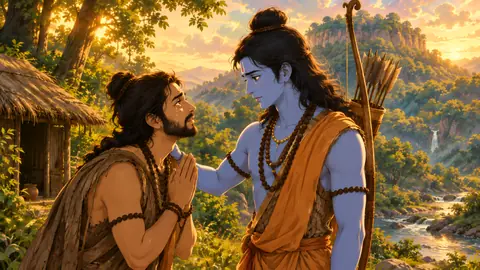
Fourteen years were complete. On the fifth day of the bright fortnight of Ashvayuja, Rama bowed before the Bharadwaja.
“Holy one, is fed and free of sickness? Is Bharata steady in his rule? Do my mothers still live?”
The smiled. “Bharata waits for you, his hair matted, his limbs smeared with mud, your sandals set before him. All is well in your house.” His austerities had shown him all that had happened since.
Rama asked one boon. “Let every tree on our way bear fruit out of season and drip with honey.”
“So be it.” For three yojanas around, bare branches burst into blossom and fruit. The feasted on thousands.
Rama looked toward and thought of a kindness.
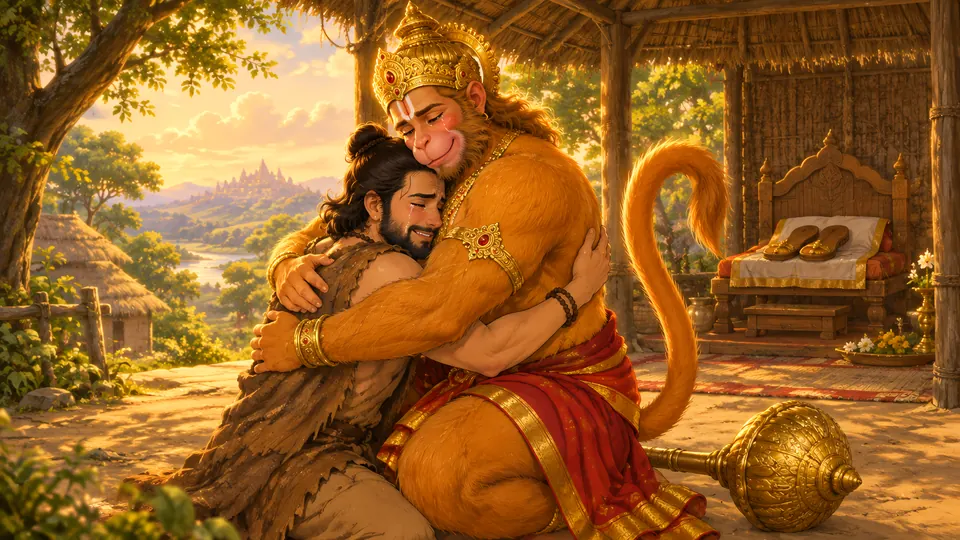 Outside a thatched hall in the village of Nandigrama, Bharata in bark clothing embraces Hanuman with tears of joy, Hanuman’s gold mace lying beside them and Rama’s gold-trimmed wooden sandals resting on a throne in the hall behind.
Scene 8 of 11
Watch his face
“Hanuman, go ahead of us. Greet Guha in my name. Then find Bharata and tell him everything. And watch his face.”
“Whose mind does not turn, given a rich kingdom from his father? If Bharata wants it, let him rule it all.”
Hanuman leapt into the sky like Garuda diving on a serpent, over the meeting of Ganga and Yamuna, to Guha, and on to Nandigrama. There sat Bharata in bark and black antelope skin, matted, thin, living on roots and fruit.
“Give up your grief. In a short while you will see Rama.”
Bharata fell to the earth, senseless with joy. When he rose, he clasped Hanuman and bathed him in tears. “Are you a god or a man, to bring me this?”
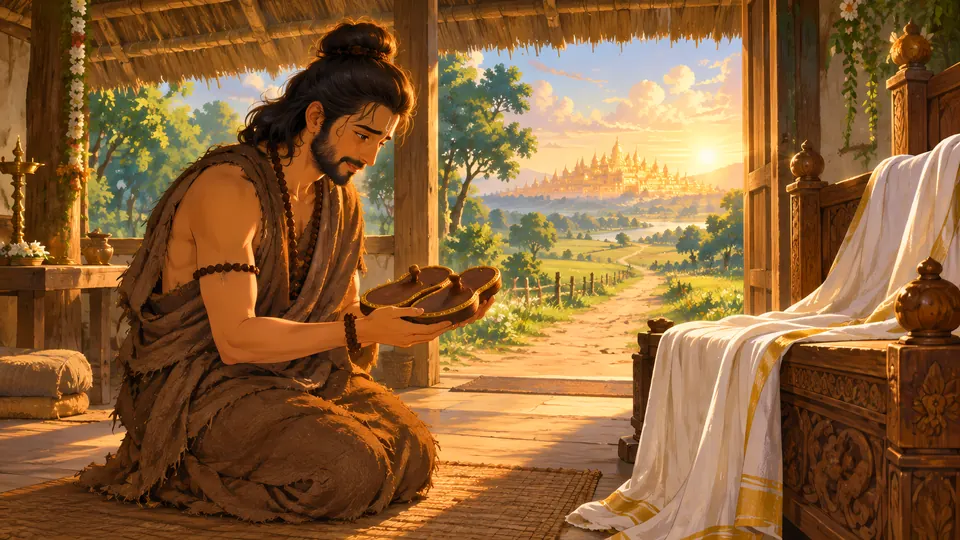 Inside a thatched hall at Nandigrama, Bharata in bark clothing kneels beside a white-draped wooden throne, holding Rama’s gold-trimmed wooden sandals in both hands, while a road through the fields leads toward a distant golden city.
Scene 9 of 11
The sandals on the throne
Two miles from , at Nandigrama, stood the royal throne. On it, for fourteen years, a pair of wooden sandals had rested under the royal canopy. Before them Bharata had ruled. While their prince lived so, the citizens would not take their pleasures either.
Now the news had come. Rama, Sita and Lakshmana were near. For the first time in fourteen years, Bharata knew joy.
Bharata raised the sandals onto his head. Beside him went the white parasol kept for Rama, and two white whisks worked in gold.
He had guarded them as a trust, not a possession. Soon, here at Nandigrama, he would set them again before Rama.
 On a marigold-garlanded terrace at sunset, Bharata kneels and sets Rama’s wooden sandals at his feet as Rama bends to raise him, with Sita and Lakshmana beside them and the people gathered beyond.
Scene 10 of 11
As you gave it, I give it back
Bharata set the sandals he had guarded beneath his brother’s feet, and joined his palms.
“You gave this kingdom to me, honouring my mother’s word. As you gave it, so I give it back. I cannot carry this load, as a young ox cannot carry what a great bull bears. A donkey cannot keep pace with a horse, nor a crow with a swan.”
“Let it be so,” said Rama, and took his seat.
Bharata bathed first, then Lakshmana, Sugriva and Vibhishana. Barbers untangled Rama’s matted locks of fourteen years, and he bathed. The widowed queens of Dasharatha adorned Sita with their own hands. Kausalya herself dressed the wives.
A chariot shining like the sun stood waiting. Bharata himself took the reins.
 Crowned Rama, a red-and-white tilak on his brow, and Sita sit together on the golden throne in a garlanded pavilion, with Lakshmana and Bharata standing at either side with joined palms and Hanuman kneeling before them.
Scene 11 of 11
Waters of four oceans
The leapt skyward with golden jars and returned with water from five hundred rivers and four seas.
Vasishtha seated Rama and Sita on a throne of jewels. The priests bathed him in those waters; maidens, ministers, warriors and merchants sprinkled him with the juices of herbs. On his head they set the crown that Manu once wore.
Rama gave Sita a string of pearls. She took it from her neck and looked from the to her husband. “Give it,” said Rama, “to the one who pleases you.” She gave it to Hanuman. He shone like a mountain under a white cloud.
When the allies had gone home, Rama asked Lakshmana to be crown prince. Pressed again and again, he declined. Rama consecrated Bharata.
You’ve reached the end of this story.
The end
How this story closes
He shone like a mountain under a white cloud.