The Sun warns his son in a dream; Indra is coming, and Karna has never refused anyone.
Karna’s Kavach Kundal. Also known as: Karna and Indra.
Tap an underlined word for its meaning.
 At night in a moonlit palace bedchamber, Karna, in his golden armour and earrings, sleeps on a carved bed while a handsome young brahmana glowing with soft golden light leans over him and speaks.
Scene 1 of 9
A brahmana in the dream
Night, in the thirteenth year of the Pandavas’ . Karna lay asleep on a rich bed, and into his dream walked a handsome brahmana, versed in the Vedas, who spoke softly, like a father.
“Listen, my son. Indra is coming for you. He will come dressed as a brahmana, for the sake of the Pandavas, and he will beg for your earrings and your armour. The whole world knows you never refuse anyone who asks. This time, refuse him. Offer him gems, women, cattle. Those ornaments were born with you; they sprang from amrita. While you wear them, no foe can kill you.”
Karna asked the stranger, “Who are you, who care for me so?”
“I am he of a thousand rays.”
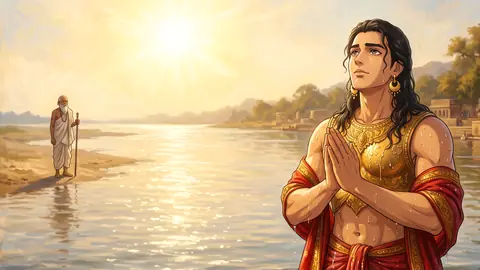
 At sunrise, Karna stands alone in profile on the riverbank in his golden armour and earrings, palms joined toward the great rising sun across the shining water.
Scene 2 of 9
A garland on a corpse
“Fortunate am I, that the god of light seeks my good,” Karna said. “But the world knows my vow. If Indra begs, he shall have them. My fame stays whole; the shame will be his.”
“Kin and fame serve only the living,” the Sun pressed. “A dead man’s fame is a garland on a corpse’s neck.” There was a secret here, he said, the gods’ own; Karna would know it in time.
“Death does not frighten me as untruth does,” Karna answered.
“Then give them, on condition. Ask for his dart that never misses.” And the god was gone.
Next day, after prayers, Karna told the Sun his dream. “It is even so,” the Sun smiled.
And Karna waited for the god who would beg.
 In a lamplit palace hall at midnight, young Pritha bows slightly and holds out a dish of food to a tall, stern brahmana with matted locks, a long beard and a wooden staff.
Scene 3 of 9
A guest who came at midnight
The secret lay years back, in King Kuntibhoja’s palace. A tall brahmana came, bearded, with matted locks and a staff in hand, blazing with splendour, asking to be the king’s guest. The king gave his care to his adopted daughter Pritha, whom the world knows as Kunti. “Anger him,” he warned, “and our whole race will burn.”
The guest said he would come at morning, and came at night. At midnight he demanded, “Give me food!” Every time Pritha answered, “All is ready,” and held out the dish.
“Is he satisfied?” her father asked each morning and evening.
“Exceedingly well.”
After a full year the brahmana found no fault. He gave her a mantra: any god she called by it must come. Then he vanished.
 Seated on her bed in an open pavilion, young Kunti joins her palms and looks up at the smiling, crowned sun god Surya, haloed in rays, while the sun still shines behind him and faint gods watch from the clouds.
Scene 4 of 9
Called out of curiosity
Alone, the girl wondered what the mantra could do. Seated on her bed one morning, she gazed and gazed at the rising sun, and suddenly she was given celestial sight. She saw the god himself, in armour, with earrings.
She called him. He came at once, honey-gold, smiling, with diadem and armlets, lighting every direction. By yoga he had divided himself in two, so that one Sun still burned in the sky.
“Go back, lord,” she begged. “I called you only out of curiosity.”
But a god called by a mantra cannot go back in vain, he said. Refuse him, and he would curse her, her father and the brahmana. “Look,” he said.
She looked up. The gods stood in the sky, watching.
 In a lamplit inner room, young Kunti looks down sorrowfully at the glowing newborn in her arms, who wears a tiny golden breastplate and golden earrings, as her old nurse kneels beside her.
Scene 5 of 9
Armour made of amrita
Trembling, Kunti weighed her father’s safety against her good name. At last she spoke: if she must bear a son of the Sun, let him be born with armour and earrings, mighty-armed.
“He shall,” said Surya. “His earrings and his armour will be made of amrita. Aditi gave these earrings to me; I will give them to him.”
The god touched her navel, and by yoga placed his own self within her womb, and she fell back on her bed like a broken creeper. “You will bear the foremost of all who wield weapons,” he said, “and you will remain a virgin.”
She hid it in the maidens’ rooms; only her nurse knew. In time a boy was born in shining armour, with brilliant earrings.
 Under a pale moon, a weeping Kunti kneels at the river’s edge and releases a lidded wicker basket onto the dark water, while her old nurse stands anxiously behind her.
Scene 6 of 9
The basket on the Ashva
With her nurse she laid him in a smooth wicker basket, lined with soft sheets and coated with wax. At dead of night, weeping, she carried her child to the river Ashva.
“May Varuna guard you in the water, and the deity who ranges the skies guard you in the sky,” she cried. “May Surya, your father, protect you everywhere. Even in foreign lands I shall know you by this armour. Blessed is the woman who will see you crawl in the dust, and grow like a maned lion of the Himalayan forests.”
She set the basket on the current and hurried back, fearing her father. It floated from the Ashva into the Charmanvati, into the Yamuna, into the Ganga, as far as Champa.
 On the Ganga bank, Adhiratha kneels and holds open a wicker basket in which a glowing baby boy lies in golden mail, a golden earring at his ear, while Radha kneels beside it with her hands to her heart in joy.
Scene 7 of 9
A boy like the morning sun
On the bank of the Ganga, Radha, wife of the charioteer Adhiratha, who had long longed for a son, saw a box riding the waves. Adhiratha drew it ashore and prised it open. Inside lay a boy like the morning sun, in golden mail, his face lit by earrings. “The gods have sent him to us,” Adhiratha said.
The brahmanas named him Vasusena. He learned arms from Drona, Kripa and Parashurama, became Duryodhana’s friend and Arjuna’s challenger. Yudhishthira looked at that armour, thought him unslayable, and grieved.
Each midday Karna rose from the river and worshipped the Sun with joined hands, and brahmanas came to ask him for wealth. One midday a brahmana stood before him and said only, “Give me!”
“Welcome,” said Karna.
 On a sunlit riverbank beneath a great tree, smiling Karna in his golden armour and earrings raises an open hand in welcome to an old brahmana with long white hair and beard, in white robes, who leans on his staff and holds out his other hand.
Scene 8 of 9
Anything but the thunderbolt
“A necklace of gold? Fair maidens? Villages rich in cattle? Which will you have?”
“None of these. If your vow is true, cut off this armour born with your body, and these earrings, and give them to me.”
Karna offered land, fields, then the whole earth. The brahmana asked for nothing else. At last Karna smiled.
“I knew you before this, Shakra. You are lord of the gods; it is you who should give boons to me. If I give you these for nothing, I am destroyed and you are laughed at. Take them, but in exchange for something.”
“Surya told you everything,” said Indra. “Be it as you wish. Ask for anything but the thunderbolt.”
“Give me your dart that is never baffled.”
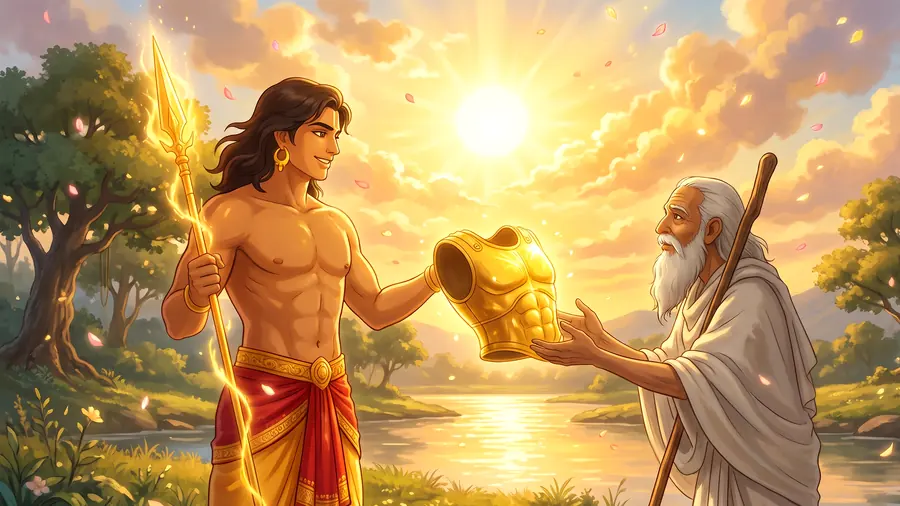
 Beneath a blazing sun with petals falling, bare-chested Karna, still wearing his earrings and holding a blazing golden spear, smilingly hands his glowing golden armour to the old brahmana, who receives it with both hands.
Scene 9 of 9
The dart that kills once
“In my hand it slays hundreds and returns,” said Indra. “In yours it will slay one mighty foe, then return to me, roaring and blazing. But your foe is guarded by Krishna, Narayana himself.”
“Even so, give it. I will cut them from my body; only let it not be left unsightly.”
“No scar shall remain. But hurl it in anger, with other weapons left and your life not in peril, and it falls on you.”
“Then I will hurl it only in mortal peril.”
Karna took the blazing dart and cut the armour from his flesh. Gods, men and Danavas roared. He smiled as he cut. Celestial drums sounded, flowers fell. He handed Indra the armour, still dripping, then cut away his earrings.
You’ve reached the end of this story.
The end
How this story closes
“Then I will hurl it only in mortal peril.”