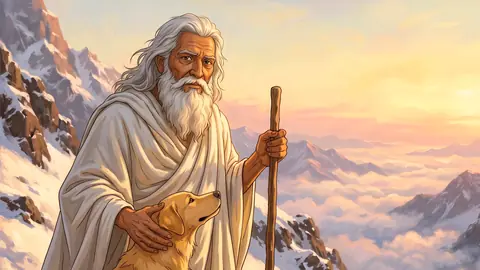
On the road toward Mount Meru, past the Himalaya and the desert, Indra’s chariot comes for Yudhishthira. Heaven is his, in his own body, on one condition: leave behind the dog at his side.
Yudhishthira and the dog. Also known as: Mahaprasthana (the great departure).
Tap an underlined word for its meaning.
 Seen from behind, the white-haired, white-robed Yudhishthira climbs a snowy Himalayan trail with his wooden staff while a light-brown dog walks close at his side, high above a sea of golden clouds under a low sun.
Scene 1 of 7
The one who stayed
Past the Himalaya, past a vast desert of sand, the road had run on toward Meru, highest of all mountains. Yudhishthira walked on alone. Or almost alone.
Behind him on that bare road lay those who had set out with him. Draupadi had fallen first. Then, one after another, his brothers. The kingdom was far behind, given up, left with everything else a king could leave.
Beside him padded a dog.
It had followed them out of the city and come the whole way. It carried no name worth announcing, no splendour, nothing to suggest it mattered to anyone but the man it walked beside. The wind ran over the empty heights.
Then a sound filled the sky and the earth together.
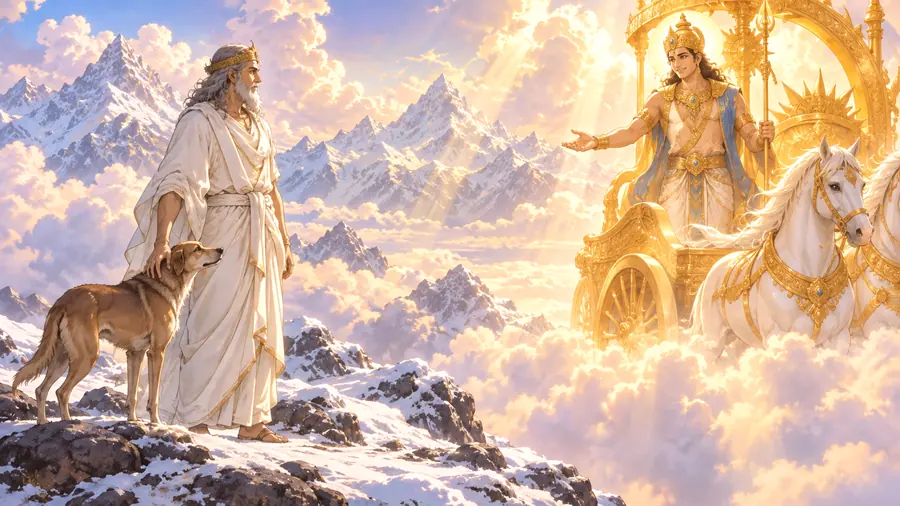 On a snowy peak above the clouds, Yudhishthira, an old king in white, rests his hand on the dog at his side as Indra beckons from a radiant golden chariot drawn by white horses.
Scene 2 of 7
A chariot out of the sky
Indra, king of the gods, came down on a chariot, and the roar of his coming filled heaven and earth. He bade the king ascend.
Yudhishthira did not move. “My brothers have fallen here. They must come with me. Without them I do not wish to go to heaven. And Draupadi should come with us.”
“You will see them in heaven,” said Indra. “They are there before you, all of them, with Draupadi. Do not grieve. They cast off their human bodies. You are ordained to go in this very body of yours.”
The king looked down at the dog at his feet.
“This dog is deeply devoted to me. He should go with me. My heart is full of compassion for him.”
 On a snowy Himalayan summit, the white-bearded Yudhishthira, holding a wooden staff, rests his hand on the head of a light-brown dog leaning against him, while Indra, crowned and in golden armour, points toward the dog from a radiant golden chariot drawn by white horses on the clouds.
Scene 3 of 7
Cast off the dog
“Immortality, O king,” said Indra. “A state equal to mine. Prosperity on every side, the highest success, every joy of heaven: you have won all of it today. Cast off this dog. There is no cruelty in that.”
The chariot blazed above them. And the dog leaned against the king’s leg, asking for nothing, because it could not ask.
Yudhishthira laid his hand on its head.
“O thousand-eyed one,” he said, “for one who lives by righteousness, an unrighteous act is very hard to do. I do not want that union with prosperity if its price is casting off one who is devoted to me.”
The king of the gods was not finished.
 Leaning on his wooden staff at the edge of a snowy ridge, the white-haired Yudhishthira looks down in sorrow toward the empty trail winding into the valleys, one hand on the head of the light-brown dog sitting against his leg, while Indra’s golden chariot, drawn by white horses, glides on the glowing clouds at the right.
Scene 4 of 7
Why not this dog?
“There is no place in heaven for men with dogs,” said Indra. “The Krodhavasas carry off their merit. Abandon it.”
Yudhishthira would not. To abandon one who is devoted, he answered, was a sin equal to slaying a Brahmana, and he had sworn a vow against it.
Indra pressed harder. “Every offering a dog looks upon is taken. You left your brothers. You left Draupadi. You have renounced everything. Why not renounce this dog?”
“All the worlds know there is neither friendship nor enmity with the dead,” said Yudhishthira. “When my brothers and Draupadi died, I could not bring them back. So I left them. But I did not leave them while they lived.”
At his feet, the dog’s flank rose and fell.
 On a snowy Himalayan summit, the aged Yudhishthira kneels with one arm around his dog, refusing to leave it, as Indra waits in his golden chariot on the clouds.
Scene 5 of 7
Till my life ends
“To frighten one who has sought protection,” the king went on, “to slay a woman, to steal what belongs to a Brahmana, to injure a friend: each of these four, I hold equal to abandoning one who is devoted.”
He had given Indra his vow at the first demand, and it held:
“I never give up one who is terrified. Nor one devoted to me. Nor one who seeks my shelter, saying he has no one. Nor one afflicted, nor one who has come to me, nor one too weak to protect himself, nor one who only wants to live. I will never give up such a one, till my own life ends.”
The gods’ chariot waited. The king did not step toward it.
 On the snowy summit above golden clouds, radiant Dharma raises a hand in blessing as Yudhishthira joins his palms before him; the golden chariot waits in the distance.
Scene 6 of 7
The dog’s true face
Then the dog became himself, god of righteousness, the god Yudhishthira knew as his father. Well pleased, he spoke sweetly, in praise.
“You are well born, king of kings. You have the wisdom and the conduct of Pandu, and compassion for every creature. Once before I tested you, my son, in the Dwaita forest, where your brothers lay as if dead. You passed over Bhima and Arjuna and asked for Nakula’s life, for the good of your stepmother Madri. Today, believing this dog devoted to you, you gave up the very chariot of the gods rather than give up him.”
Yudhishthira joined his palms.
“Therefore, O king,” said , “there is no one in heaven equal to you. Worlds of unending joy are yours.”
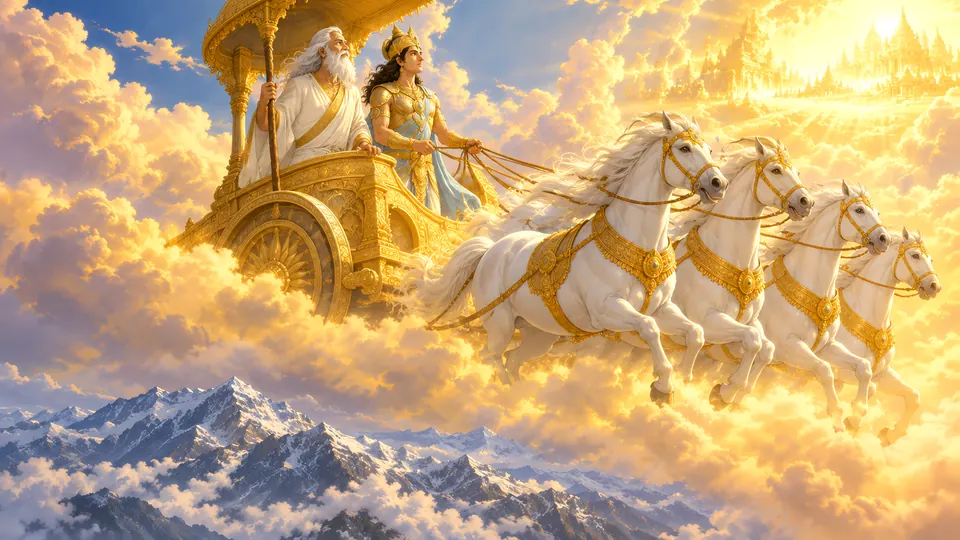 Yudhishthira stands beside Indra in the golden chariot as four white horses carry them through glowing clouds above the Himalaya toward heaven.
Scene 7 of 7
The sky catches fire
and Indra, the Maruts, the Ashvins and the celestial rishis raised him onto the chariot, and it rose. The whole sky blazed with his radiance.
From among the gods, Narada spoke. “Every royal here is surpassed by Yudhishthira. He has come to heaven in his own human body. No one else has ever been heard to do it.”
The king bowed to them all. “Happy or miserable, wherever my brothers are now, there I wish to go. Nowhere else.”
“Stay here,” said Indra. “You have won this place by your deeds. Why do you still cling to human affections?”
Yudhishthira’s answer did not change. “I wish to go where my brothers have gone. Where Draupadi has gone.”
You’ve reached the end of this story.
The end
How this story closes
“I wish to go where my brothers have gone. Where Draupadi has gone.”