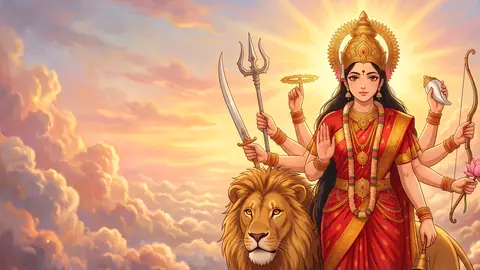
A king robbed of his throne and a merchant cast out by his own family kneel by a river and shape the Goddess from earth. Three years later, she answers, and each must name what he truly wants.
King Suratha and Samadhi. Also known as: Suratha and the merchant Samadhi.
Tap an underlined word for its meaning.
 Before his thatched forest hermitage at sunset, the white-bearded sage Medhas in a saffron robe sits on a grass mat and gestures gently towards King Suratha, in a worn red cloak, and the merchant Samadhi, in a beige shawl, who sit before him with palms joined.
Scene 1 of 7
The sage falls silent
In the hermitage, the Medhas fell silent. The Goddess, her battles, her boundless mercy: he had told it all.
Before him sat two men who had reached his forest hermitage by different roads. King Suratha, whose own ministers had seized his treasury and his army. The merchant Samadhi, robbed of his wealth and driven out by his wife and sons, greedy for what he owned.
And still, each had confessed, his mind kept running back to what had wounded him.
Medhas lifted his hand. “Go to her, great king. Take refuge in the Supreme Goddess. Worshipped, she grants the joys of this world, heaven, and release.”
Neither man spoke. Both were already rising.
 On a quiet riverbank at golden hour, King Suratha in a worn red-and-gold cloak and the merchant Samadhi in a beige shawl kneel side by side, shaping a small seated clay image of the Goddess with their hands.
Scene 2 of 7
Clay on the riverbank
They bowed to the . And they went.
No throne waited at the water’s edge, no ledger, no crowded market. Only the river, the sandbank and the quiet. There the king and the merchant knelt side by side and began to shape the Goddess with their own hands.
Fingers that had once gripped a sceptre and counted coin now pressed wet earth into form. A seat. Shoulders. A face.
The image rose between them, small and still. They laid flowers before it and offered incense and fire.
Then they sat down before her, and did not get up.
 At sunrise on a misty riverbank, King Suratha and the merchant Samadhi sit with eyes closed and palms joined before a small clay image of the Goddess, among fallen leaves.
Scene 3 of 7
Three years
Day after day, the river found them there.
They chanted the hymn to the Goddess. They ate less, then less again, until they ate nothing at all, their minds fixed on her alone, their senses held in check. They offered her bali sprinkled with blood drawn from their own bodies.
Seasons turned slowly around the silent clay image.
One year. Two. Three.
They sat shoulder to shoulder, yet each prayed alone. The king was still a king without a kingdom. The merchant’s lips moved, and no one could say for what.
Still they did not rise.
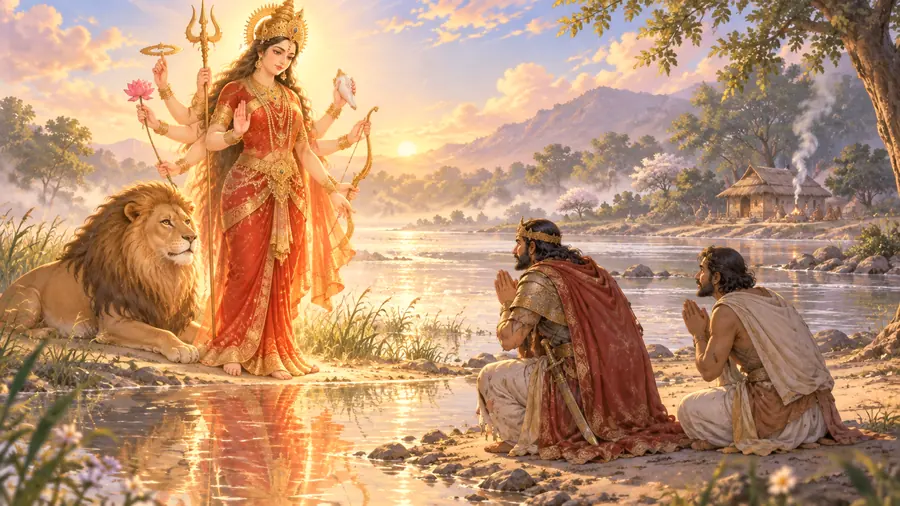 By a river at sunrise, the many-armed Goddess in red stands beside a lion, holding a lotus, a trident and other emblems, as a king in armour and a man in plain cloth kneel before her with joined hands.
Scene 4 of 7
She comes
Then the riverbank blazed with light.
Before the little clay image, the Goddess herself appeared: Chandika, the mother of the world, no longer shaped from earth but standing before their eyes. The two men sank to their knees, palms joined.
Her voice reached them both. “I am pleased with you. Whatever you seek, O king, and you, joy of your family, ask it of me, and it shall be yours.”
Three years had narrowed to this single breath.
The king’s thoughts flew to his city, the city his forefathers had guarded, the throne torn from him. The merchant’s turned to the bond of “I” and “mine” he longed to be free of.
The king lifted his head first.
 On the riverbank at sunset, the eight-armed Goddess, her lion beside her, raises a hand in blessing toward King Suratha, who stands with joined palms as the merchant Samadhi waits behind him.
Scene 5 of 7
The king asks
“Give me back my kingdom.” Suratha’s voice did not waver. “My own kingdom, in this very life, with the strength of my enemies broken. And in the life to come, a kingdom that can never be lost.”
Beside him, Samadhi made a request of his own.
The Goddess answered the king first.
“In a few days, O king, you will regain your kingdom. You will strike down your foes, and it will stand firm in your hands.”
Then her words reached further, past this life, past death itself. “And when you die, you will be born again of the Sun god, Vivasvan. On earth you will be a Manu. Savarni will be your name.”
Then she turned to the merchant.
 On the riverbank at sunset, the eight-armed Goddess blesses the merchant Samadhi, who bows with joined palms, while King Suratha stands behind him and her lion rests nearby.
Scene 6 of 7
The merchant asks
What Samadhi had asked was something else.
He had lost his wealth. He had lost his home. Yet he asked for neither.
Wise, his heart already turned from the world, he asked instead for the knowledge that cuts the bond of “I” and “mine”, the knowledge that frees a man from clinging.
He knew that bond too well. His own family had driven him out, and still his heart had run after them.
The Goddess answered him.
“Best of merchants, the boon you have sought from me, I give you. For your perfection, knowledge shall be yours.”
Samadhi stayed bowed a long moment. When he raised his head, the river looked no different. He did.
 Seen from behind at sunset, King Suratha in his red cloak and the merchant Samadhi in his beige shawl walk away from the riverbank on two diverging paths, one towards distant hills and the other into a glowing forest, as a faint shimmer of golden light lingers where the Goddess stood.
Scene 7 of 7
She is gone
The two men praised her with all their devotion. And in that very instant, she vanished.
Only the river remained, and the small clay image on the sand where she had stood.
One road now led back towards a kingdom that waited to be won. The other led towards the knowledge the merchant had been promised.
The king rose and turned towards his city. The merchant turned the other way. Neither looked back.
And in time, as she had foretold, Suratha would be born of the Sun, to become the Manu Savarni.
Behind them, the clay Goddess sat alone on the sand, and the riverbank fell silent.
You’ve reached the end of this story.
The end
How this story closes
Behind them, the clay Goddess sat alone on the sand, and the riverbank fell silent.