His mother catches the butter thief and reaches for a rope. Every rope in the house, knotted together, comes up two fingers short.
Damodar Leela. Also known as: Makhan Chori, Ukhal Bandhan.
Tap an underlined word for its meaning.
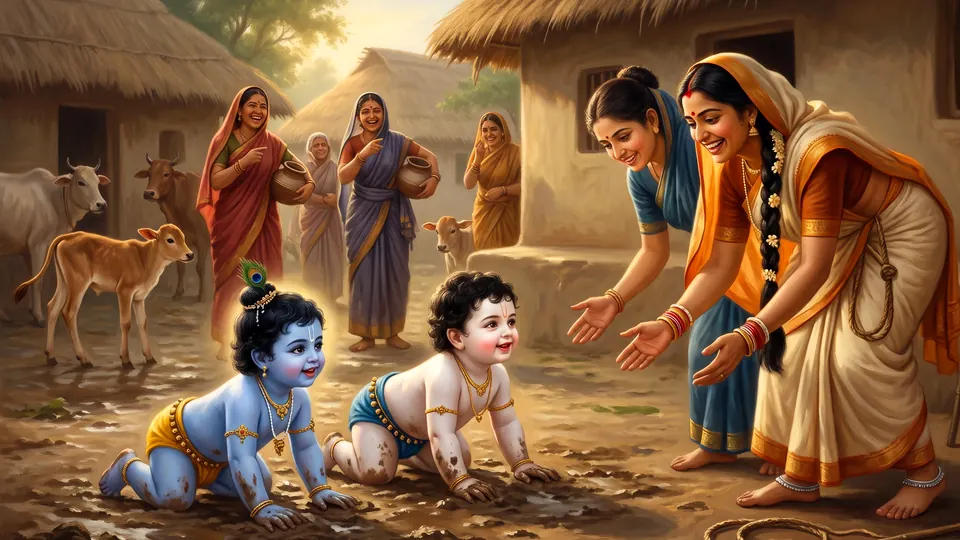 Two mud-smeared infant boys, the blue Krishna and the fair Balarama, crawl through the mud of a thatched cowherd village as their two smiling mothers bend down to gather them up, while a calf stands near and village women laugh in the background.
Scene 1 of 9
Bells in the mud
Two small boys crawled through the mud of Gokula on hands and knees, and wherever they went, little bells rang.
Balarama and Krishna dragged their legs behind them like snakes. Delighted by the sound, they crawled after anyone who passed; then took fright and hurried back to their mothers. The mothers gathered them up, mud and all, and nursed them, lost in two smiles that showed a few small teeth.
They caught calves by the tail and were hauled about, and the women of left their work to laugh.
Horns, fire, fangs, blades, water, birds, thorns: the mothers could keep them from nothing, and had no peace.
Soon both were walking, and playing with the boys of .
Then the complaints began.
 Yashoda, seated on a low stool, laughs with her arm around the small blue Krishna, who stands wide-eyed and innocent at her knee, while a row of cowherd women, some holding pots, point at him and complain.
Scene 2 of 9
Like a good boy
The gopis came in a crowd, and Krishna’s mother listened.
“He unties our calves at the wrong hour and laughs when we shout. He invents ways of thieving and eats our curd and milk. He feeds the monkeys, and when they will take no more, he breaks the pot. Finding nothing, he turns on the household and leaves the babies crying.
“Hang the pots out of reach, and he climbs stools and the mortar. He knows what each holds, and bores a hole in it. In a dark room his own jewels are his lamp.
“And look at him now, sitting like a good boy!”
They turned to his lovely face, his frightened eyes. Yashoda only laughed. She had no wish to scold him.
 In a firelit room the small Krishna, frowning with tears in his eyes, lifts a stone beside the big earthen churning pot while Yashoda, flowers falling from her braid, runs to the hearth where the milk is boiling over.
Scene 3 of 9
The milk boils over
Yashoda, Nanda’s wife, was churning the curd herself; the housemaids had other work. As she pulled the rope she sang of everything her child had done. Bangles slid on her tired arms, her earrings swung, her face was damp, and malati flowers dropped from her braid.
Krishna came wanting her milk. He caught the churning rod and stopped it.
He climbed into her lap and she nursed him, her eyes on his smiling face. The milk on the fire rose over the rim. She put him down, still hungry, and ran.
Angry, he bit his trembling red lip. His tears were false. He took a stone and broke the churning pot.
Then he went inside, alone, and began on the butter.
 The small Krishna, butter on his face, runs as if frightened while Yashoda chases him with a thin stick, her hair shaken loose and flowers falling behind her; a monkey eats butter on the mortar and a pot hangs from a rope sling.
Scene 4 of 9
The chase
Yashoda took the milk off the fire and came back to a broken pot and no child. She knew whose work it was, and laughed.
She found him on an upturned mortar, feeding a monkey butter from the hanging sling, his eyes darting like a thief’s. She crept up behind him.
He saw her stick, jumped down and ran, as if afraid. She ran after him: after one whom the minds of yogis, driven by austerity, cannot reach. Her hair shook loose. Flowers fell behind her.
She caught him.
He cried, rubbing his eyes until the kohl smeared, looking up in terror. She held his hand and scolded. Then she saw his fear, and threw the stick away.
She would tie him up instead.
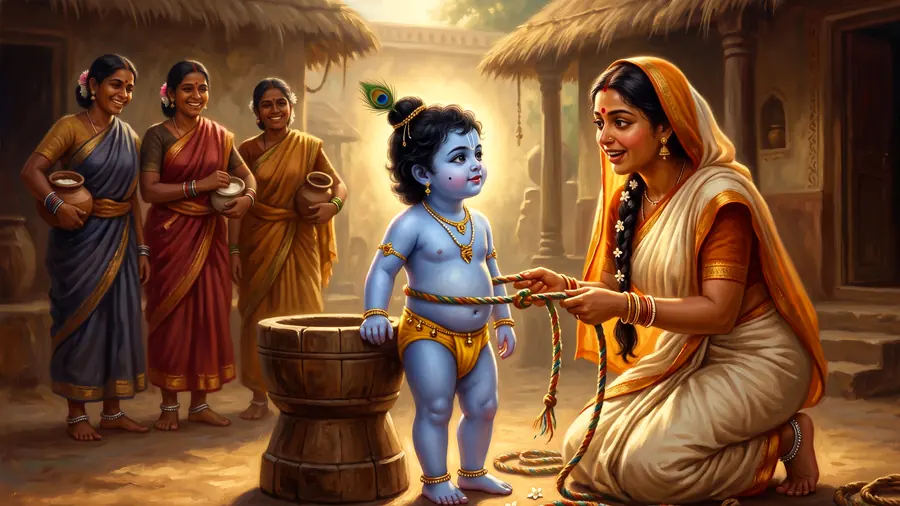
 Kneeling in the courtyard, Yashoda wraps a long rope of many knotted coloured pieces around the belly of the small blue Krishna beside a wooden mortar, looking at him in smiling wonder, as three cowherd women watch and smile.
Scene 5 of 9
Two fingers short
She did not know whose strength she meant to tie.
He has no inside and no outside, no before and no after. He is the world’s before and after, its inside and outside. He is the world. The cowherd woman took him for her son, and brought a rope to bind him to the mortar like any child.
The rope was two fingers short.
She joined another to it. Two fingers short. Another. Two fingers. She knotted together every rope in the house, and still it would not close. The gopis were smiling. Yashoda smiled too, astonished.
Sweat ran down her; the flowers were slipping from her hair. Krishna saw how tired his mother was.
Out of pity, he let himself be bound.
 Two crowned princes laugh waist-deep in a lotus-filled river below snowy peaks, young women around them in the water up to their shoulders, as the white-bearded sage Narada with his veena approaches along the bank.
Scene 6 of 9
Two arjuna trees
Not Brahma, not Shiva, not Lakshmi herself, says the Shuka, was ever given what that cowherd woman was given.
She went back to her housework. The child at the mortar looked at two arjuna trees.
Once they had been Nalakuvara and Manigriva, sons of Kubera, the giver of wealth, until Narada cursed them.
“What had they done,” King Parikshit asked Shuka, “to anger the of the gods?”
They were attendants of Shiva, swollen with pride. In a garden on , beside the Mandakini, they drank varuni until their eyes rolled, and roamed the flowering woods, women singing behind them. They waded into the lotus-crowded Ganga and played with the young women like two elephants among she-elephants.
Narada happened to come that way.
 On the riverbank the sage Narada raises his hand to pronounce his word over the two crowned princes still standing waist-deep among the lotuses, while between them three young women, wrapped in saris, hide their faces in their hands and turn away.
Scene 7 of 9
The sage’s curse
The women saw the and, ashamed, fearing his curse, dressed at once. The two brothers, drunk, blind with wealth, did not.
Narada meant them a kindness. He gave it as a curse.
“Nothing ruins the mind like pride of wealth. For one so blinded, poverty is the best eye-salve: the poor man sees every creature as like himself.
“These two are sons of a world-guardian, yet so sunk in darkness they do not know they are unclothed. Let them stand as trees, and never be so again. By my grace they will remember. After a hundred years of the gods they will come before Vasudeva, regain heaven, and love him.”
He went on to Narayana’s ashram. The brothers became twin arjuna trees.
 The small blue Krishna strains forward with a rope around his belly, dragging a wooden mortar caught against two great pale-barked trees whose roots are tearing out of the ground in a burst of soil and leaves.
Scene 8 of 9
Between the trunks
Tied to the mortar, Krishna thought of Narada.
“The of the gods is very dear to me. What that great soul sang over these two sons of Kubera, I will bring about.”
Slowly he went toward the twin trees, the mortar dragging behind him. He passed between the trunks. The mortar swung crosswise and stuck.
He pulled: Damodara, the Bhagavata calls him here, the boy with the rope around his belly.
The roots tore loose. Trunks, leaves and branches shuddered under his strength, and both trees came down with a terrible crash.
Where they fell, two shining beings rose like fire out of wood, lighting every direction. They bowed their heads to Krishna, lord of all the worlds, and joined their palms.
 Among fallen tree trunks, the small Krishna, still roped to the mortar lying on its side, laughs as two glowing crowned beings in golden silk and garlands bow to him with joined palms.
Scene 9 of 9
Northward
“Krishna, Krishna, great yogi! You are the first and highest person. Homage to you, Vasudeva, lord of the Yadus. We serve your servant; the ’s kindness let us see you. Give us leave. May our tongues tell of you, our ears hear of you, our hands do your work, our minds rest at your feet.”
The Lord of Gokula, roped to a mortar, laughed.
“I knew it long ago. The in his compassion did you a kindness. Go home, Nalakuvara, both of you. The love you wanted is born in you.”
They circled him, bowed again and again, took leave of the child tied to the mortar, and went north.
Later commentators place this day at Dipavali; tradition keeps it in Kartik, Damodara’s month.
You’ve reached the end of this story.
The end
How this story closes
The love you wanted is born in you.