Asked his family, he has only his mother’s plain answer, and gives it word for word. A bull, a fire and two birds teach him the rest.
Satyakama Jabala. Also known as: Satyakama and Jabala, Chandogya Upanishad story.
Tap an underlined word for its meaning.
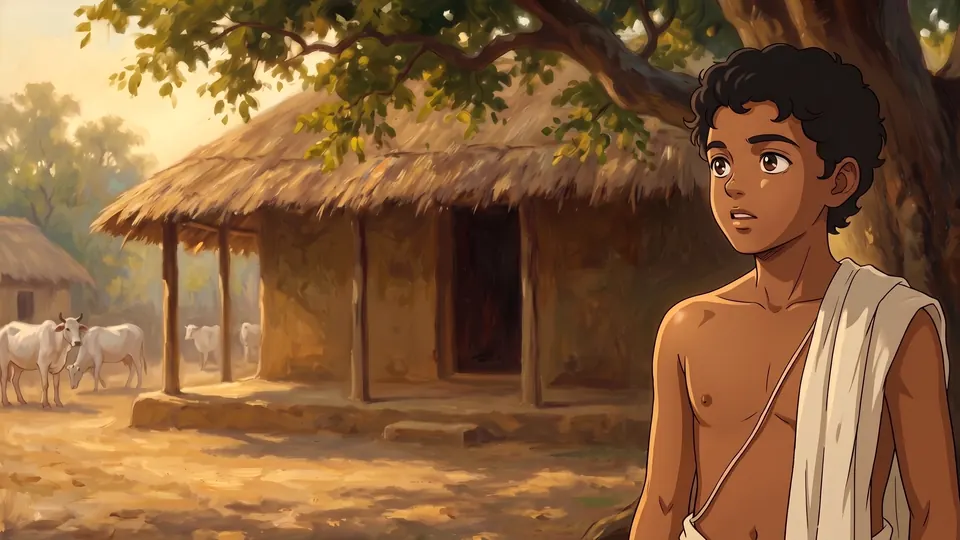
 Satyakama, a dark-skinned curly-haired boy, looks up at his mother Jabala outside their plain mud house as she rests a hand on his shoulder and answers him plainly and calmly.
Scene 1 of 7
Of what family am I?
“Mother,” said Satyakama, “I wish to live as a student of sacred knowledge. Of what family am I?”
His mother was Jabala. She answered him.
“I do not know, my child, of what family you are. In my youth I moved about a great deal as a serving woman, and in those days I had you. So I do not know of what family you are. But my name is Jabala, and your name is Satyakama. Say only that you are Satyakama Jabala.”
He went to Gautama Haridrumata.
“Sir, I wish to live with you as a student. May I come to you?”
“Of what family are you, my friend?” asked Gautama.
 In the swept yard of a thatched house, the boy Satyakama stands straight and answers the white-bearded teacher Gautama, who looks down at him with a warm, dawning smile; lean and sturdy cows of a herd stand in the yard behind them.
Scene 2 of 7
Fetch the fuel
“I do not know, sir, of what family I am,” said Satyakama. “I asked my mother, and she answered me: ‘In my youth I moved about a great deal as a serving woman, and in those days I had you. I do not know of what family you are. But my name is Jabala, and your name is Satyakama.’ So I am Satyakama Jabala, sir.”
Gautama spoke.
“No one but a true brahmana could speak so. Go and fetch the fuel, my friend. I shall initiate you. You have not swerved from the truth.”
He initiated him. Then he picked out four hundred cows, lean ones, weak ones.
“Go after these, my friend.”
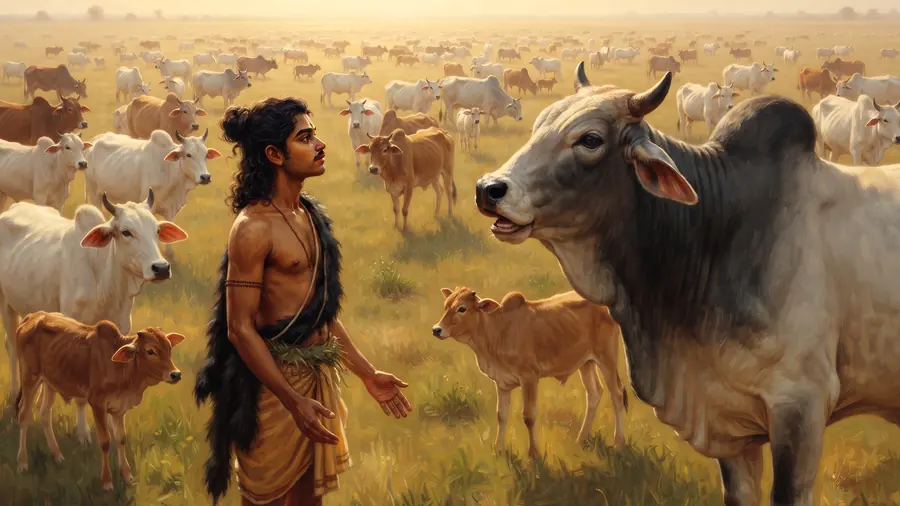
 Years later, the grown Satyakama stands with open empty hands in a great herd of cows and calves on an open plain while the huge pale-grey herd bull turns its head and speaks to him.
Scene 3 of 7
Not without a thousand
As he drove them out, Satyakama said, “I shall not come back without a thousand.”
He lived away for a number of years.
When the cows had become a thousand, the bull of the herd spoke to him. “Satyakama!”
“Sir!”
“We have reached a thousand, my friend. Take us to the teacher’s house. And let me tell you one foot of Brahman.”
“Tell me, sir.”
“The east is one part. The west is one part. The south is one part. The north is one part. This, my friend, is a foot of Brahman, in four parts. It is called Prakashavat, endowed with splendour. Whoever knows it so and meditates on it wins the worlds of splendour.
“Agni, the fire, will tell you another foot.”
 At evening Satyakama sits cross-legged beside a small fire of sticks as its single tall flame rises and speaks; beyond the fire his cows are penned inside a ring of thorn branches.
Scene 4 of 7
The fire speaks
Next morning Satyakama set the cows on the road to the teacher’s house.
Where evening found them, he lit a fire. He penned the cows. He laid wood on the fire and sat down behind it, facing east.
The fire spoke to him. “Satyakama!”
“Sir!”
“My friend, let me tell you a foot of Brahman.”
“Tell me, sir.”
“The earth is one part. The sky is one part. Heaven is one part. The ocean is one part. This, my friend, is a foot of Brahman, in four parts. It is called Anantavat, the endless. Whoever knows it so and meditates on it becomes endless in this world, and wins endless worlds.
“A hamsa, a swan, will tell you another foot.”
 The next evening, with the cows penned beyond the fire in their ring of thorns, Satyakama sits beside his small fire as a single white swan flies down with wings spread.
Scene 5 of 7
A swan at evening
Morning came, and he drove the cows on.
Evening again. Again the fire lit, the cows penned, the wood laid on; again Satyakama sitting behind the fire with his face to the east.
A swan flew down to him. “Satyakama!”
“Sir!”
“My friend, let me tell you a foot of Brahman.”
“Tell me, sir.”
“Fire is one part. The sun is one part. The moon is one part. Lightning is one part. This, my friend, is a foot of Brahman, in four parts. It is called Jyotishmat, full of light. Whoever knows it so and meditates on it becomes full of light in this world, and wins worlds full of light.
“A madgu, a diver-bird, will tell you another foot.”
 On the third evening Satyakama sits beside the small fire, the cows penned beyond it, as a sooty-brown diving bird with a long neck and hooked bill stands near the fire with wings half open.
Scene 6 of 7
The diver-bird
One more morning on the road with a thousand cows. One more evening.
He lit the fire and penned the herd. He laid on the wood. He sat down behind the fire, facing east.
A diver-bird flew down to him. “Satyakama!”
“Sir!”
“My friend, let me tell you a foot of Brahman.”
“Tell me, sir.”
“Breath is one part. The eye is one part. The ear is one part. The mind is one part. This, my friend, is a foot of Brahman, in four parts. It is called Ayatanavat, having a home. Whoever knows it so and meditates on it has a home in this world, and wins the worlds that offer a home.”
Four feet, from four teachers. The teacher’s house still lay ahead.
 With hands joined and a calm light on his face, the grown Satyakama stands before the older, white-bearded Gautama in the yard of the thatched house, as the teacher studies his face with wonder.
Scene 7 of 7
Others than men
He reached the teacher’s house.
“Satyakama!” said the teacher.
“Sir!”
“My friend, you shine like one who knows Brahman. Who has taught you?”
“Others than men,” said Satyakama. “But I wish that you yourself, sir, would teach me. From men like you I have heard that only knowledge learnt from a teacher leads to the highest good.”
Then the teacher taught him that very knowledge.
Nothing was left out. Nothing was left out.
And when the Upanishad next speaks of Satyakama Jabala, he is the teacher. A student, Upakosala Kamalayana, lived in his house and tended his fires for twelve years.
You’ve reached the end of this story.
The end
How this story closes
Then the teacher taught him that very knowledge.