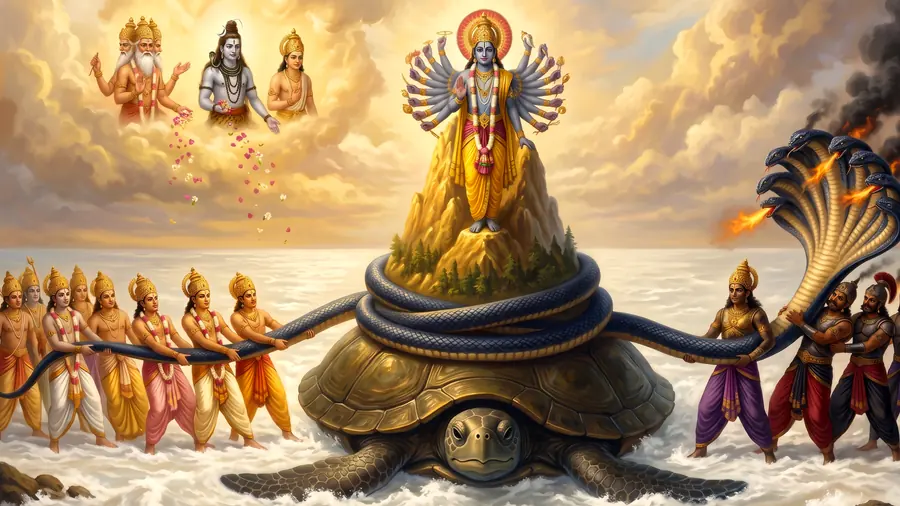
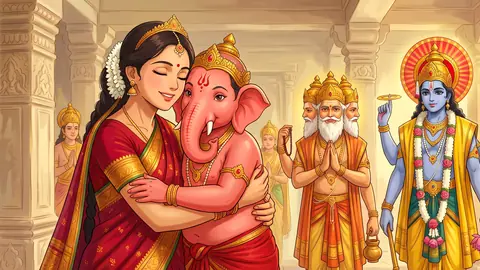
Gods and asuras churn the ocean for nectar. Poison rises first, then treasures and a goddess, and last a pot of nectar that is poured for one side alone.
Samudra Manthan. Also known as: Sagar Manthan, Amrit Manthan, the churning of the Ocean of Milk.
Tap an underlined word for its meaning.
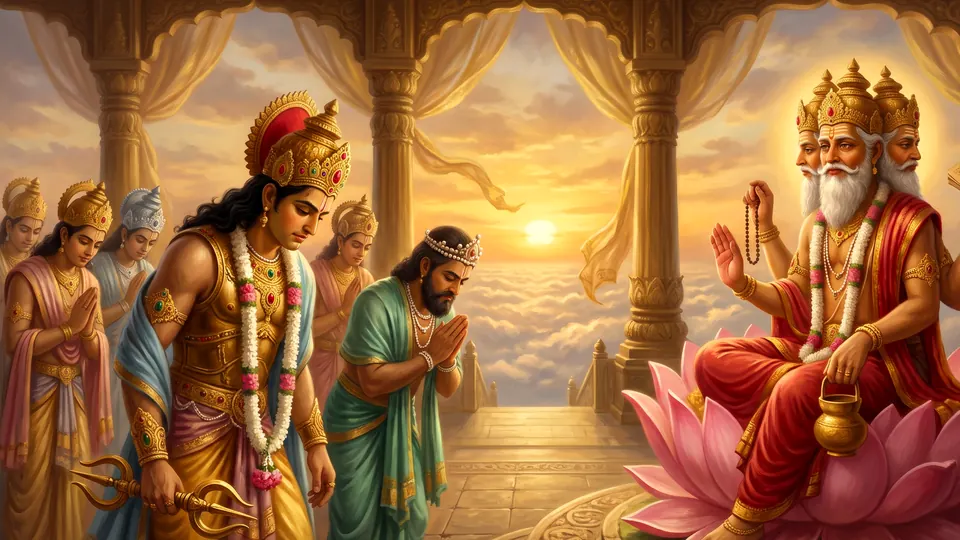 In a golden pillared hall above the clouds, four-faced Brahma sits on a pink lotus, one hand raised in blessing, as a weary Indra, a bearded Varuna and other gods bow before him.
Scene 1 of 9
The gods who did not rise
The asuras’ sharp weapons had done their work. Gods lay on the field, and many never rose again. Durvasa’s curse had stripped the three worlds of their fortune, Indra’s with them. No sacrifice could be performed.
Indra, Varuna and the rest took counsel and found no answer. They climbed to the peak of Meru, to Brahma’s assembly, bowed, and told him everything.
Brahma looked at them: strength gone, light gone, the asuras flourishing. He fixed his mind on the Lord, and his face cleared.
“I, Shiva, all of you, the asuras, every creature: we all come from him. Let us go to him.”
He led them to the Lord’s abode, beyond darkness. He had never seen the Lord. He prayed anyway: “Let us see you.”
 Four-armed Vishnu stands in a blaze of golden light with Lakshmi beside him, palms joined, small radiant figures bearing his weapons in the haze around them, while four-faced Brahma and Shiva kneel bowed to the ground before him.
Scene 2 of 9
A thousand suns
The Lord appeared, and his light was a thousand suns rising together. The gods could see neither sky nor earth.
Brahma and Shiva saw him: dark as an emerald, silk yellow as molten gold, the Kaustubha at his throat, Shri with him, his weapons standing by in living form. They fell to the ground.
His voice rolled like thunder.
“Time favours the asuras now. Make a truce with them. When the need is great, even enemies join hands: the snake and the mouse. Throw herbs into the Ocean of Milk. Mandara will be your churning rod, Vasuki your rope. Whatever the asuras ask, agree. A poison, Kalakuta, will rise. Do not fear it. Do not grasp at what comes up.”
Then he was gone.
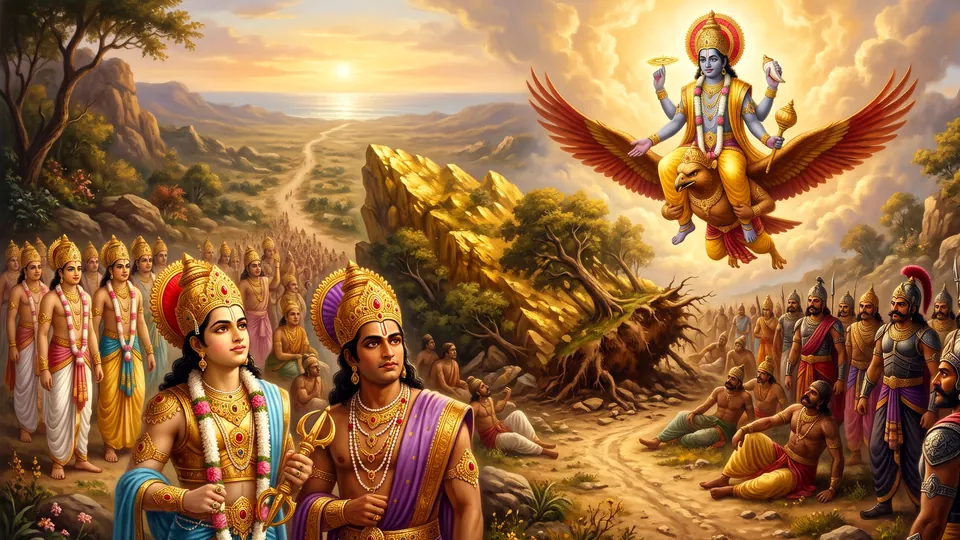 Gods and asuras rest beside the golden mountain lying uprooted on the road to the sea, as Indra and Bali look up at Vishnu descending through the clouds on Garuda.
Scene 3 of 9
The golden mountain
The gods came to Bali unready for battle. His captains sprang up to kill them. Bali, who could read the hour for peace and the hour for war, held them back.
Indra came before the son of Virochana, spoke gently and laid out the plan. Bali agreed. So did Shambara, Arishtanemi and all who dwelt in Tripura.
Together they tore Mandara from the earth and carried it, roaring, toward the sea. The way was long. Indra and Bali tired, and the bearers let it go. The golden mountain fell and crushed many of them, gods and asuras alike.
Then the Lord came on Garuda. One look, and the crushed rose whole, without a bruise. With one hand he lifted Mandara onto Garuda’s back.
 Smiling, Vishnu holds the tail of the serpent Vasuki, wound around the golden mountain in the milky sea, with the gods behind him, while Bali stands apart with folded arms among the armoured asura lords.
Scene 4 of 9
Head or tail
Garuda set the mountain down beside the water, and the Lord sent him away.
They called Vasuki, king of serpents: a portion of the nectar would be his. They wound him around Mandara for a rope. The Lord took hold of the head, and the gods fell in behind him.
The asura lords did not move. “The tail? The inauspicious end of a snake? We are learned in the Veda, famous for our birth and our deeds.” They stood silent.
The Lord smiled, let go of the head and took the tail. The gods followed him.
The sons of Kashyapa began to churn. And Mandara, with nothing beneath it, began to sink. They watched their mountain go under, and their faces withered.
 Gods and asuras haul the serpent Vasuki, wound around the golden mountain that rests on a vast tortoise in the Ocean of Milk, while the thousand-armed Lord stands on the peak pressing it down with one hand; fire bursts from the serpent’s many hoods above Bali and the soot-stained asuras, black smoke rising behind them, and Brahma, Shiva and Indra shower flowers from the clouds.
Scene 5 of 9
The tortoise beneath
Then the Lord, whose will never fails, took the form of a tortoise, went down into the sea and lifted Mandara on his back. His shell spread a hundred thousand yojanas, like another island. As they whirled the mountain, he felt it as a pleasant scratch.
He entered the asuras, the gods and Vasuki, firing their strength. On the summit he stood too, thousand-armed, a second mountain, pressing Mandara down with one hand. From the sky Brahma, Shiva and Indra praised him and rained flowers.
Vasuki’s thousand mouths breathed fire and smoke. Pauloma, Kaleya, Bali and Ilvala stood charred, like sarala trees in the wake of a wildfire. The gods’ faces and garlands blackened, until the Lord sent clouds to pour rain on them.
 On a snowy ledge above the milky sea, where dark smoke of poison spreads over the water, Shiva sits on a tiger-skin raising the poison in his cupped palm to his lips, Parvati calm beside him and white-bearded sages kneeling with joined palms, while far below the dark Lord churns beside the golden mountain.
Scene 6 of 9
Halahala
Still no nectar. So Ajita took the serpent himself and churned. Dark as a rain cloud, in golden cloth, he shone like a second mountain. Whales and crocodiles heaved to the surface.
The first thing the ocean gave up was poison: Halahala, unbearable, spreading every way.
Creatures fled to Shiva, seated on his mountain with Bhavani. The Prajapatis prayed: “Lord of gods, save us from this poison that burns the three worlds.”
Shiva turned to her. “Look at them. A master exists to protect the helpless. Let me drink it, and let them be well.”
Bhavani knew his power, and let him.
He cupped the poison in his hand and swallowed it. It left only a blue mark on his throat, which became his ornament.
 Lakshmi rises from the milky sea on a great pink lotus in a flash of lightning, a lotus in her hand, while the gods and armoured asuras on the shore gaze at her beside the white cow, the white horse, the white elephant and the flowering celestial tree.
Scene 7 of 9
What the ocean gave
They churned again with new heart.
Up came Surabhi, the cow whose milk and ghee feed the sacred fire; the took her. Then Ucchaihshrava, a horse white as the moon. Bali wanted him, and Indra, as the Lord had told him, did not object. Then Airavata, king of elephants, white and four-tusked, outshining Shiva’s white mountain, and after him the eight elephants of the directions with their eight mates. Then the jewel Kaustubha; Hari wanted it for his chest. Then the Parijata, the ornament of heaven, that grants every wish. Then the Apsaras, in gold and fine cloth.
Then a light like lightning, colouring every direction.
Shri had risen from the sea, and every eye in that crowd turned to her.
 On the shore of the milky sea, Lakshmi, smiling shyly, lays a garland of pink and white lotuses with bees about it on four-armed Vishnu, the gods standing behind him and the armoured asuras downcast on the other side.
Scene 8 of 9
The garland
Indra brought her a seat; the elephants of the directions bathed her as brahmanas chanted; Brahma gave her a lotus.
Then she walked among them, a lotus garland humming with bees in her hand. One had tapas but not mastery of anger; one, knowledge but not freedom from attachment; one, long life without good conduct.
She chose Mukunda, who needed no one. She laid the garland on his shoulders and stood beside him, smiling, shy. Her glance fell on the gods, and they flourished. The asuras, passed over, were downcast.
Then Varuni rose, lotus-eyed; with Hari’s consent the asuras took her. Then Dhanvantari, a portion of Vishnu, dark, in yellow robes, carrying a pot brimming with nectar.
The asuras tore it from his hands.
 On the shore of the milky sea, Mohini, dark as a blue lotus with jasmine in her hair, laughs as she pours nectar from a gold pot into the cup of the nearest god, the gods seated in one row with gold cups while the armoured asuras sit silent in the other; at the far end of the gods’ row Surya and Chandra point at Rahu as he drinks, a flaming discus speeding toward him through the sky.
Scene 9 of 9
Two rows
“Do not grieve,” the Lord told the gods. The asuras were quarrelling: “Me first!” “No, me!”
A woman came toward them, dark as a blue lotus, jasmine in her hair. Mohini: the Lord himself. “Divide it,” they begged.
“Sons of Kashyapa, you would trust a wandering woman?” Laughing, they gave her the pot. “Then accept whatever I do, fair or not.” “Agreed.”
She seated them in two rows and poured only for the gods. Bound by their word, the asuras kept silent.
Rahu, disguised as a god, slipped into their assembly and drank. Sun and Moon exposed him. Hari’s discus took his head. The body fell; the head, touched by nectar, lived.
As the gods were finishing, the Lord showed the asuras his own form.
You’ve reached the end of this story.
The end
How this story closes
Bound by their word, the asuras kept silent.