Spritual
Spritual
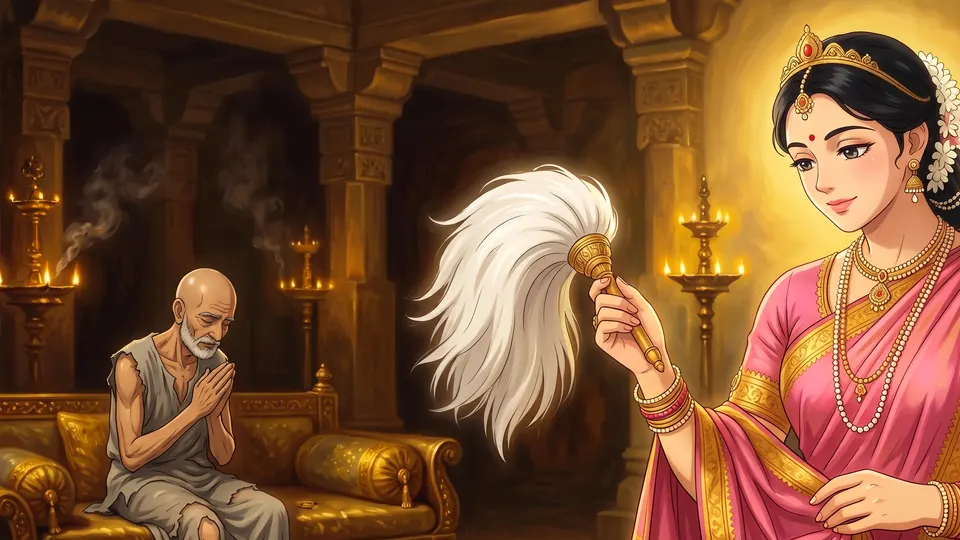
Rukmini, Krishna’s queen, in a rose-pink silk sari with gold borders and pearls, lifts a white yak-tail whisk and smiles down at the thin, ragged guest who sits with folded hands on her jewelled couch in the lamplit palace hall of Dvaraka.

Gods & Puranas

Rukmini

रुक्मिणी

Vaidarbhi · Shri

Rukmini, princess of Vidarbha and Krishna’s queen, is a portion of Shri herself, says the Bhagavata. She heard his praises sung and chose him. Promised by her brother to Shishupala, she sent Krishna a secret message by a brahmana: come for me, or I will give up my life.

Read more

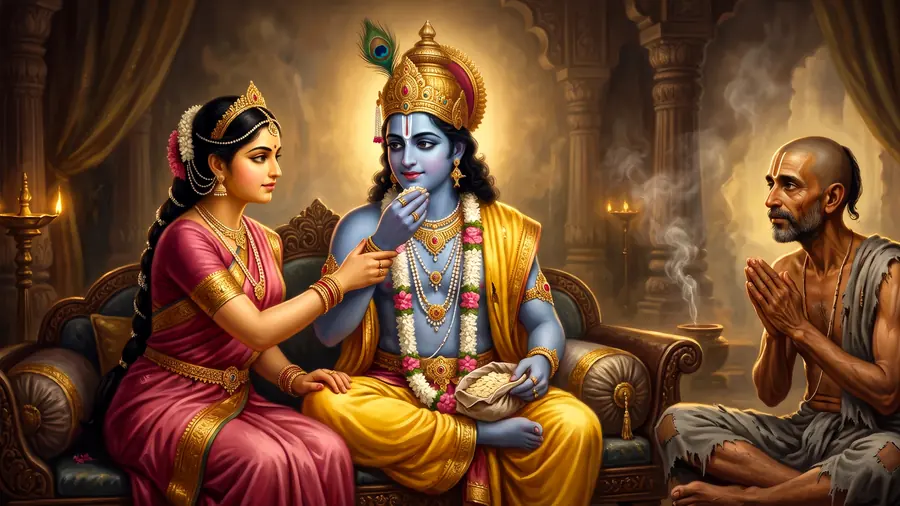
As she left Ambika’s temple, Krishna lifted her onto his chariot while his enemies looked on. Tradition holds she is the queen who fanned his ragged friend Sudama and caught Krishna’s hand at the second handful of flat rice. In all his palaces, Krishna told her, no wife loved him as she did.

  • 1 story
  • 9 scenes
  • 9 min read

Stories with Rukmini

Vishnu & KrishnaSkandha 10

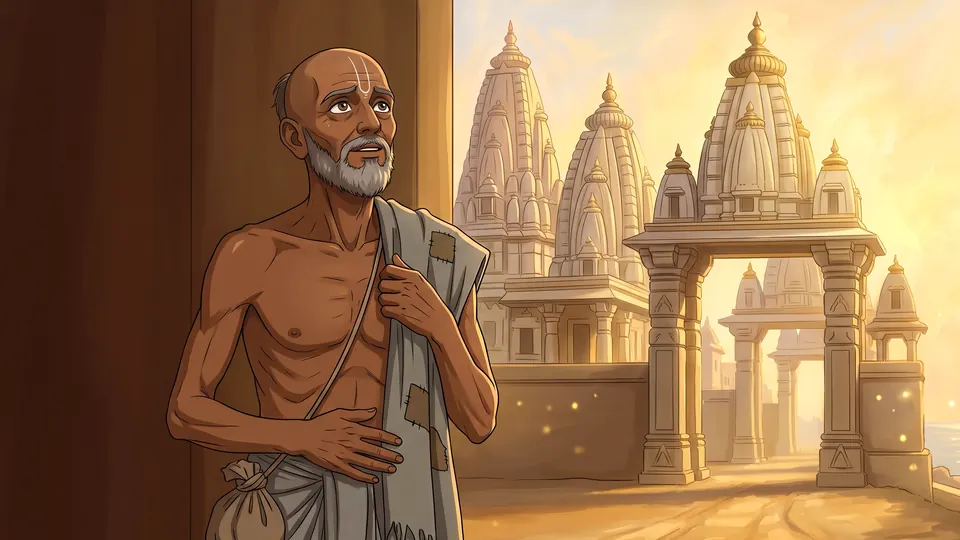
Krishna and Sudama: Four handfuls of flat rice

A ragged brahmana walks to Dvaraka with four handfuls of rice tied in a rag, too ashamed to give them. Krishna takes them himself.
  • 9 min
  • Friendship
  • Devotion

Names

Rukmini. Also known as: Vaidarbhi, Shri.

Where this comes from

What this page about Rukmini was checked against: each point, and where it is found.
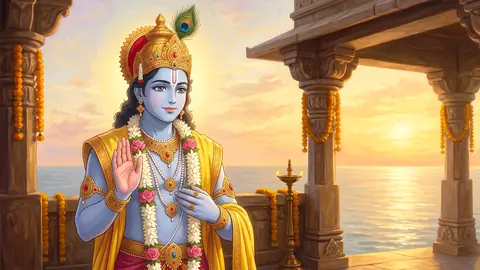
  1. Krishna seated on his beloved’s couch (priyā-paryaṅka) rises to embrace the brahmana: 10.80.18; seats him on it: 10.80.20-22, 10.81.17 Sources of the story “Krishna and Sudama”
  2. The goddess (devī) fans the brahmana with a yak-tail fan: 10.80.23; ‘his queen’ (mahiṣī) fanned me: 10.81.17 Sources of the story “Krishna and Sudama”
  3. Palace people: the Lord left Shri sitting on her couch: 10.80.25-26 Sources of the story “Krishna and Sudama”
  4. Shri seizes Krishna’s hand at the second handful, and her words: 10.81.10-11 Sources of the story “Krishna and Sudama”
  5. The queen in the Sudama story is identified as Rukmini by tradition: the verses say only śrī, devī, mahiṣī, priyā, and the Bhaktivedanta gloss on 10.81.10 reads śrīḥ as Rukmiṇī-devī. The commentaries themselves have not been checked. Sources of the story “Krishna and Sudama”
  6. The title Vaidarbhi and “a portion of Shri herself”: Govinda married Bhishmaka’s daughter Vaidarbhi, a portion of Shri (Sanskrit “vaidarbhim bhishmaka-sutam shriyo matram”), by her own choice (“svayamvare”) Bhagavata Purana 10.52.16-17 (Sanskrit verse text and word glosses read; Bhaktivedanta translation on Vedabase, paraphrased)
  7. The title Shri: Krishna beholds her as Shri in person who has no goal but him (“rupinim shriyam ananya-gatim”); she is called Rama, the goddess of fortune, at her wedding and after (“rukminya ramaya”) Bhagavata Purana 10.60.9; 10.54.60; 10.60.58
  8. “Princess of Vidarbha”: Bhishmaka, king of Vidarbha, had five sons, Rukmi the eldest, and one daughter, Rukmini Bhagavata Purana 10.52.21-22
  9. “Heard his praises sung and chose him”: hearing visitors to the palace sing of Mukunda’s beauty, prowess, character and glory, she thought him a fitting husband; in her message, “you are chosen by me as husband” (“bhavan khalu vritah patih”); Krishna later says she sent the brahmana having heard true accounts of him Bhagavata Purana 10.52.23; 10.52.39; 10.60.55
  10. For the line ‘promised by her brother to Shishupala’: Rukmi, hostile to Krishna, overruled the family’s wish and settled on Caidya (Shishupala) Bhagavata Purana 10.52.25
  11. “Secret message by a brahmana”: she sent a trusted brahmana to Krishna; the brahmana calls what he brought confidential messages (“guhya-sandeshah”); Krishna recalls the messenger with her secret counsel. (A “letter” is the translator’s and tradition’s word; the verses say message, so the retelling says message) Bhagavata Purana 10.52.26; 10.52.44; 10.60.57
  12. For the line ‘come for me’: I have given myself to you, come and make me your wife; come to Vidarbha and win me by valour Bhagavata Purana 10.52.39; 10.52.41
  13. For the line ‘or I will give up my life and wait a hundred births’: if I do not win your grace I will give up my life, worn thin by vows; it may come after a hundred births (‘jahyam asun vrata-krishan shata-janmabhih syat’) Bhagavata Purana 10.52.43
  14. “As she left Ambika’s temple, Krishna lifted her onto his chariot while his enemies looked on”: she leaves the Ambika temple; Krishna carries off the princess, who was ready to mount his chariot, as his enemies watch (“dvishatam samikshatam”), and lifts her onto it Bhagavata Purana 10.53.50; 10.53.51-55; 10.53.56
  15. “Krishna’s queen”: Krishna brought Bhishmaka’s daughter to his capital and married her by Vedic rite Bhagavata Purana 10.54.53
  16. The closing line, “In all his palaces, Krishna told her, no wife loved him as she did”: “I see no loving wife like you in my houses” (“na tvadrishim pranayinim grihinim griheshu pashyami”) Bhagavata Purana 10.60.55
  17. “Tradition holds she is the queen who fanned his ragged friend Sudama and caught Krishna’s hand”: drawn from the other lines above (10.80.23 devi fans with yak-tail whisk; 10.81.10-11 Shri catches his hand at the second handful). The verses name neither her nor Sudama here; both names are tradition’s, and the retelling marks them so. Bhagavata Purana 10.80.7, 10.80.23, 10.81.10-11

With them in these stories

Everyone in the stories

Reading comfort

Text size
Colour

Colour waits while Night Lamp is on.

Motion

Light mode keeps the paintings still, with one slow drift and no depth effect. Easier on older phones and batteries.

Night Lamp

Warm amber text on near-black. Paintings fade slowly and hold still.

Rama turned to his teacher and asked for the knowledge of withdrawal.

Saved on this device.